
Appendix 2 - Tax Resources and Tax Forms
Summary :Two very different skills sit behind every completed tax return: knowing where to find authoritative rules when a question comes up, and knowing what the client's own paperwork is actually telling you. This appendix pairs both. The first half is a short map of where practitioners go to find the primary law and free training rather than relying on secondhand summaries. The second half looks at the small set of information returns, forms other parties send to the IRS and to the taxpayer, that a preparer typically has in hand before Form 1040 can even be started.
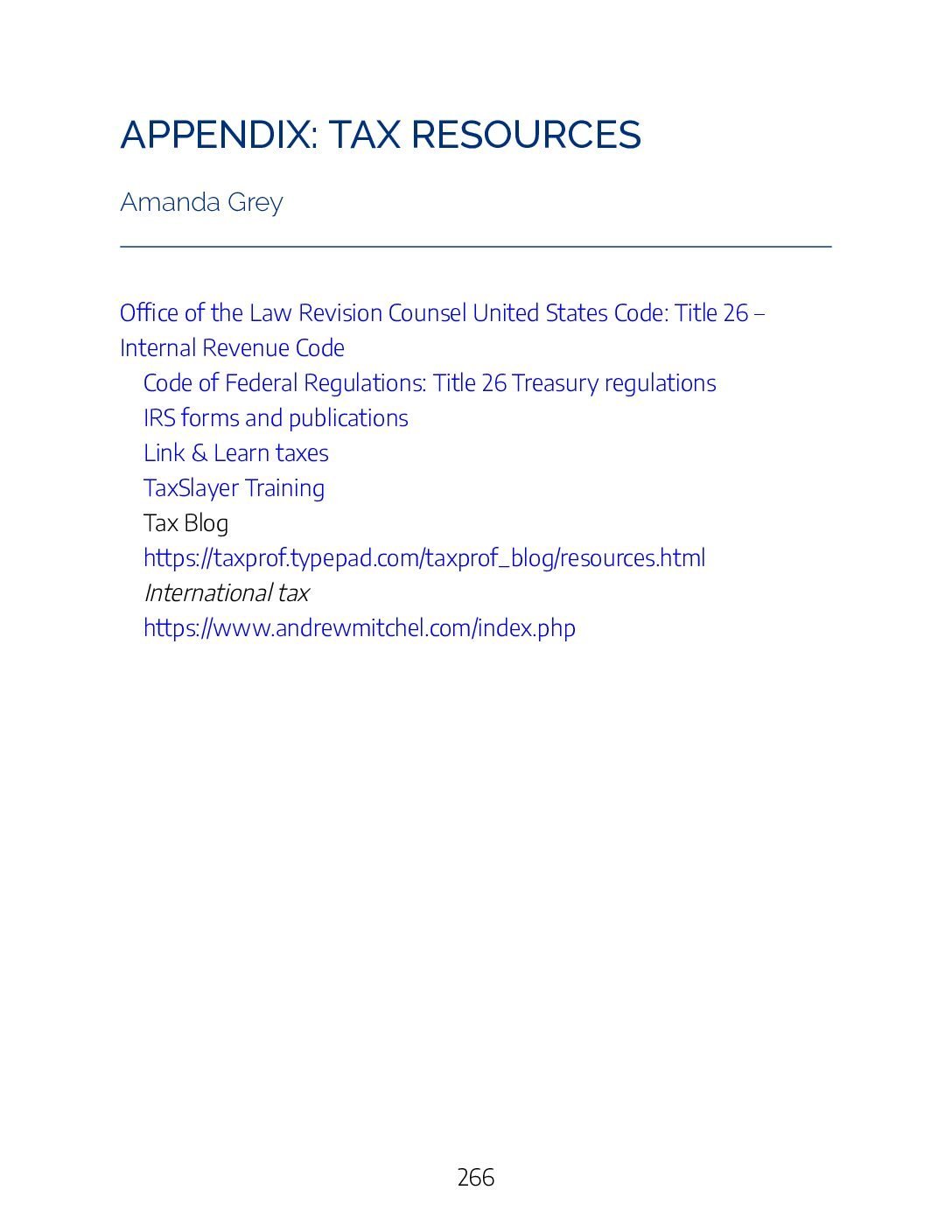
Primary Legal Text: The Law Revision Counsel and the CFR
The Office of the Law Revision Counsel of the U.S. House of Representatives maintains the official, current text of the United States Code, including Title 26, the Internal Revenue Code. This is the actual statute Congress enacted, and it is the single most authoritative source a researcher can consult, since every other source, including the summaries and outlines used in coursework, is ultimately built on top of it.
The Code of Federal Regulations, specifically Title 26, contains the Treasury regulations that interpret and implement the Code. Where the statute sets the rule, the regulations often supply the detail: definitions, examples, elections, and procedural requirements that the bare statutory text does not spell out. A researcher who has located the relevant Code section should generally check the corresponding CFR Title 26 regulation next, since the two are meant to be read together.
IRS Forms, Publications, and Free Training Resources
The IRS itself publishes the forms, instructions, and topic-specific Publications that most preparers reach for first, precisely because they translate the statute and regulations into plain, applied guidance, even though, as covered elsewhere in this course, they are secondary authority and not a substitute for the primary law when a position needs to be defended.
Link & Learn Taxes is the IRS's own free e-learning platform, originally built to train volunteer preparers in the VITA and TCE programs, and it remains a useful, no-cost way to work through return-preparation scenarios step by step. Commercial platforms such as TaxSlayer also offer structured training built around their software, which is useful both for learning the software itself and for reinforcing how a given tax rule actually gets applied on a real return.
Staying Current: Tax Blogs and Specialized Research Sites
Because tax law changes constantly through new legislation, regulations, and court decisions, static textbooks age quickly on the details even when their underlying framework stays accurate. Tax-focused blogs written by academics and practitioners help bridge that gap, tracking recent developments, summarizing new cases, and flagging provisions that are about to change or expire.
Specialized sites focused on a single area, such as international tax, serve a similar purpose for practitioners who need depth in one subject rather than a general overview. These sites are still secondary sources and should be used the way IRS Publications are used: as a fast way to get oriented on an issue, followed by confirmation against the primary statute or regulation before relying on the conclusion.
Form W-2: Reporting Wages and Withholding
Form W-2, the Wage and Tax Statement, is issued by an employer to each employee and, separately, to the IRS and Social Security Administration, reporting total wages paid during the year along with federal income tax, Social Security tax, and Medicare tax withheld. It is the starting point for almost every individual return that includes employment income, since the wage figure it reports flows directly into gross income and the withholding figures it reports are credited against the employee's total tax liability.
Because the IRS receives its own copy of every W-2 issued, the information-matching process described elsewhere in this course depends heavily on this form; a return that omits or misreports W-2 income is one of the more easily detected discrepancies the IRS can flag.
Form 1099-NEC and Form 1099-R: Nonemployee Pay and Retirement Distributions
Form 1099-NEC reports nonemployee compensation, the payments a business makes to an independent contractor or freelancer rather than an employee. Because no tax is withheld from these payments the way it is from W-2 wages, the income reported on a 1099-NEC is generally subject to self-employment tax in addition to ordinary income tax, which is one of the most consequential differences between being paid as an employee and being paid as a contractor.
Form 1099-R reports distributions from pensions, annuities, retirement or profit-sharing plans, IRAs, and certain insurance contracts. Depending on the type of account and the taxpayer's age at the time of distribution, some or all of the amount reported may be taxable, and an early distribution can also trigger an additional penalty, so the codes printed on the form itself are important for determining exactly how the distribution should be treated.
Form 1099-G and Form 1099-B: Government Payments and Investment Transactions
Form 1099-G reports certain payments made by government agencies, most commonly unemployment compensation and state or local tax refunds. Unemployment compensation is generally taxable as ordinary income, while a state tax refund is only taxable in the (fairly common) situation where the taxpayer itemized deductions in the prior year and received a tax benefit from deducting state taxes at that time.
Form 1099-B reports proceeds from broker and barter exchange transactions, essentially a record of securities sold during the year along with, in most cases, the broker's own tracking of cost basis. This form is the primary source document for calculating capital gains and losses on investment sales, and its basis information is what a preparer reconciles against the taxpayer's own records when the two do not agree.
How These Information Returns Feed Into Form 1040
Each of these forms exists so that income earned outside a traditional paycheck still reaches the IRS through third-party reporting rather than relying solely on the taxpayer's own disclosure. Collectively, they are the raw material a preparer gathers before Form 1040 can be completed accurately: wages and withholding from the W-2, contractor income from the 1099-NEC, retirement income from the 1099-R, government payments from the 1099-G, and investment gains and losses from the 1099-B.
Because the IRS receives copies of all of these forms independently of the taxpayer, any income reported on one of them that does not appear on the filed return is one of the most common triggers for the information-matching audit selection process. A careful preparer treats the full set of information returns a client brings in as a checklist to reconcile against the return before it is filed, not simply as source documents to transcribe.
Quick revision summary
- The Office of the Law Revision Counsel publishes the official text of the Internal Revenue Code (Title 26); the CFR Title 26 contains the corresponding Treasury regulations.
- IRS Publications, Link & Learn Taxes, and commercial training platforms are useful secondary starting points, not primary authority.
- Form W-2 reports employee wages and withholding; the IRS receives its own copy, making it central to information-matching audits.
- Form 1099-NEC reports nonemployee (contractor) compensation, which is generally subject to self-employment tax.
- Form 1099-R reports retirement plan and annuity distributions; Form 1099-G reports items like unemployment compensation and state refunds.
- Form 1099-B reports proceeds (and often basis) from securities sales and is the primary source for calculating capital gains and losses.