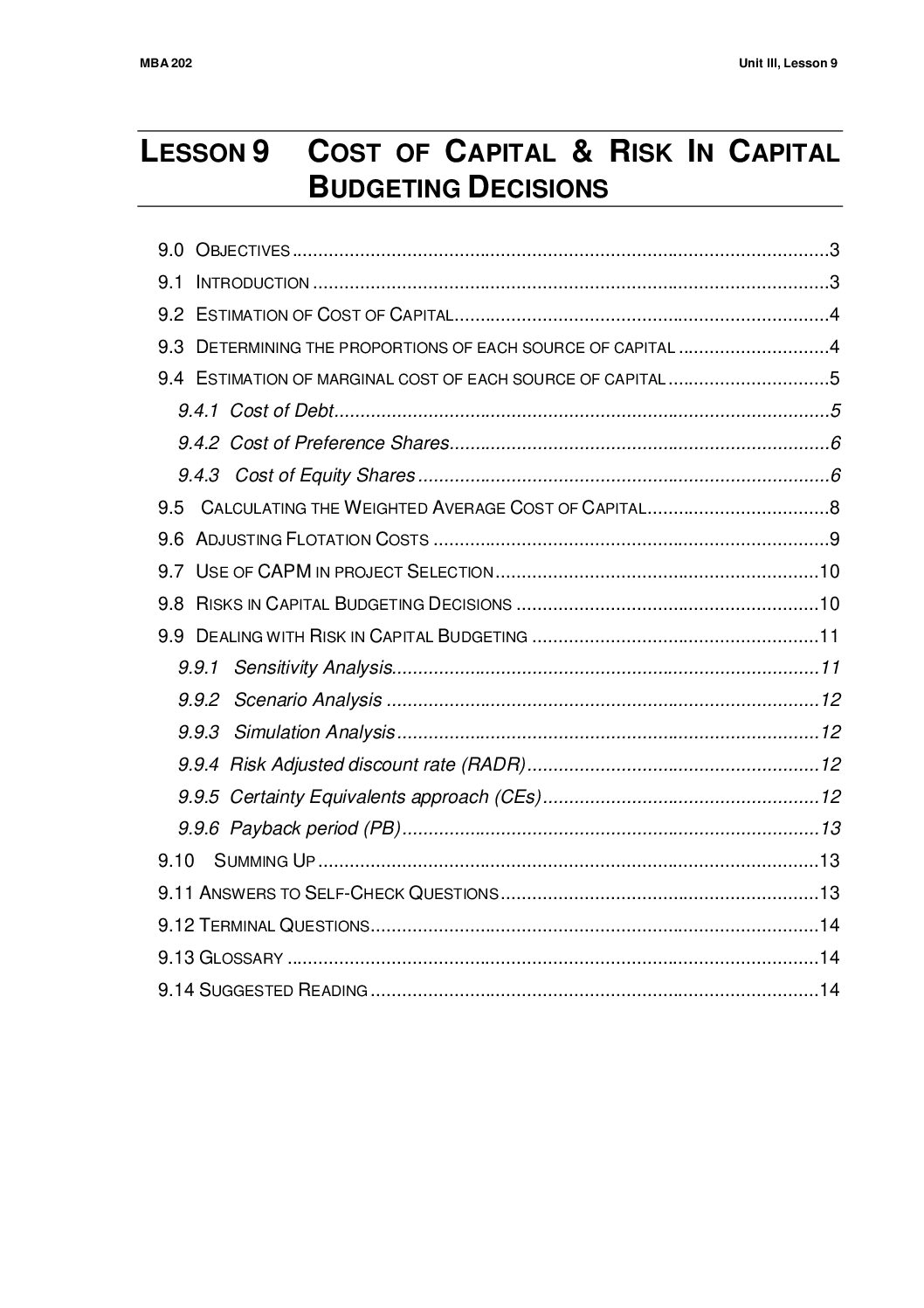
This lesson explains the estimation of cost of capital, including calculations for debt, equity, and preference shares. It discusses WACC, CAPM application, risk analysis (sensitivity, scenario, simulation), risk-adjusted discount rates, and certainty equivalents for practical risk management in project investments.
This lesson details capital budgeting evaluation methods, including discounted and non-discounted cash flow techniques (NPV, IRR, PI, payback). It tackles mutually exclusive projects, capital rationing, multiple IRR issues, and post-completion audits, supporting students in making sound investment appraisal decisions
This lesson focuses on the nature and process of capital budgeting, types of capital budgeting decisions, project proposal classification, estimation principles for various cash flows, and terminal value calculations. Practical illustrations highlight risk, project screening, and decision-making processes for long-term investments.
This covers a systematic approach to solving time value of money problems, using real-world timelines and reference points for cash flows. It covers step-by-step methods, interpolation techniques, and provides a mini case study applying concepts for retirement and college funding plans.
This comprehensive guide analyzes China’s shift towards advanced economy status, covering economic trends, consumption shifts, digital transformation, innovation, global expansion, and productivity-led growth. It offers strategic insights for CEOs and policymakers aiming to navigate China’s evolving market landscape over the next decade, with focus on opportunities in productivity, digitization, and globalization.