
Appendix 1 - Selected Internal Revenue Code
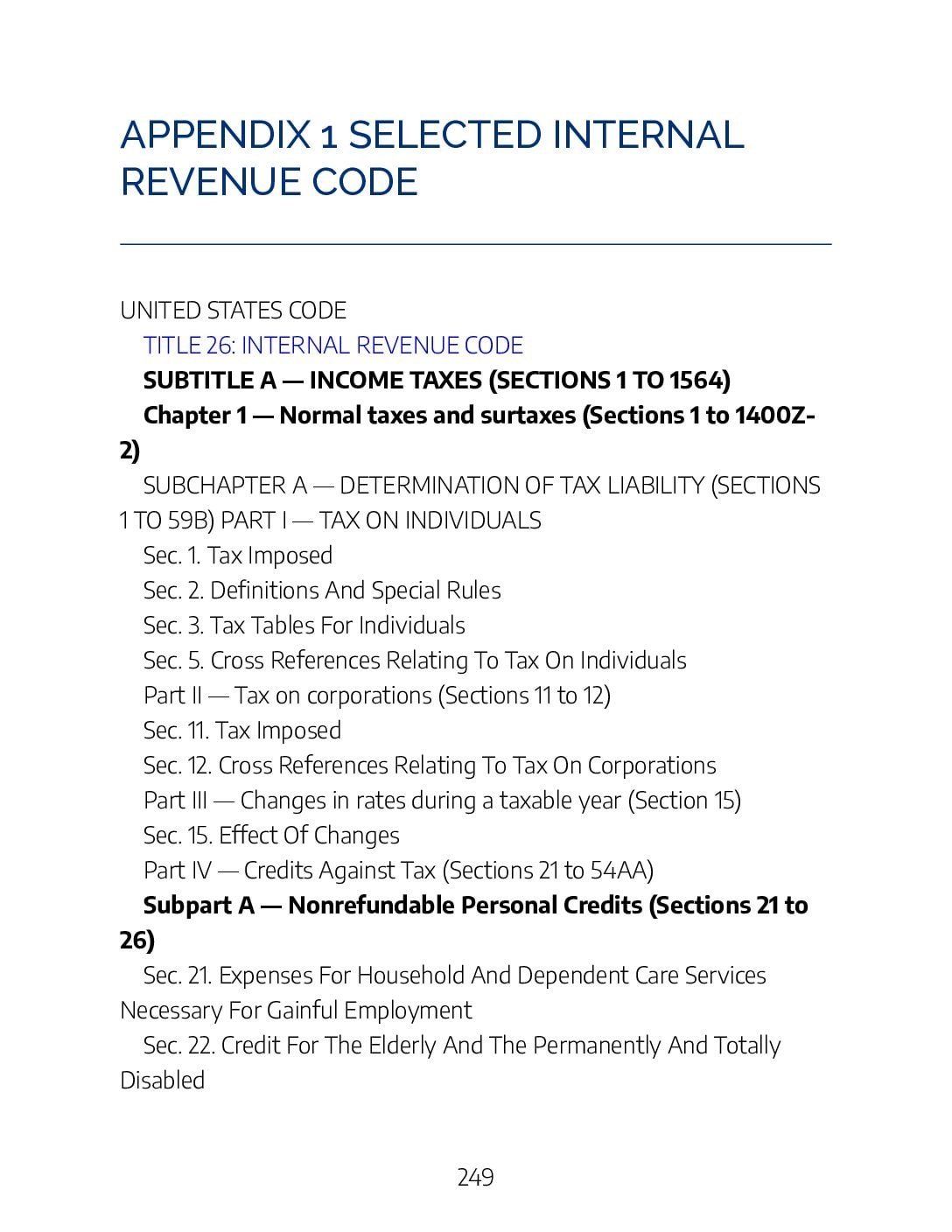
Summary :The Internal Revenue Code is Title 26 of the United States Code, and it is enormous, running to thousands of sections covering everything from individual income tax to estate tax to alcohol excise duties. A student or new practitioner opening the Code for the first time can be overwhelmed simply by its scale. This appendix exists as a navigational reference, a selected outline of the Code's major divisions and the section numbers that fall within them, so that a researcher can go straight to the right neighborhood of the Code instead of searching blindly. Understanding how the Code is organized is a separate skill from understanding any single provision within it, and it is one of the most practical skills a tax student can build.
Why the Code's Structure Matters
Tax research almost always starts with narrowing down where in the Code an answer is likely to live. Someone researching a question about a business deduction does not need to look anywhere near the estate tax provisions, and someone researching payroll withholding does not need to search through capital gains rules. Knowing the Code's structure lets a researcher rule out entire sections of law immediately, which is often more valuable than knowing the answer to any single question, because the same navigational skill applies to every new question that comes up.
The structure also matters because related rules are grouped together on purpose. When a provision about itemized deductions is unclear, the surrounding sections in the same Part are usually a good place to look for related definitions, exceptions, or cross-references. The Code's organization is not arbitrary; it reflects decades of legislative drafting that groups similar tax concepts near each other.
Title, Subtitle, and Chapter: The Top of the Hierarchy
At the broadest level, the Code is a single Title, Title 26. Below that, it is divided into Subtitles, identified by letters, each covering a major category of federal tax: Subtitle A covers income taxes, Subtitle B covers estate and gift taxes, Subtitle C covers employment taxes, Subtitle D covers miscellaneous excise taxes, Subtitle E covers alcohol, tobacco, and certain other excise taxes, and further subtitles cover procedure and administration, the Joint Committee on Taxation, and several other specialized areas.
Within a Subtitle, the next level down is the Chapter. Subtitle A, for example, contains Chapter 1 (normal taxes and surtaxes, which is where the bulk of income tax law lives), Chapter 2 (self-employment tax), Chapter 2A (the unearned income Medicare contribution), Chapter 3 (withholding on nonresident aliens and foreign corporations), and several more. A researcher who identifies the right Chapter has usually narrowed a multi-thousand-section Code down to a manageable few hundred sections.
Subchapters, Parts, and Individual Sections
Below Chapter, the Code divides further into Subchapters, identified by letters, and then into Parts, identified by Roman numerals. Chapter 1's Subchapter A, for instance, covers the determination of tax liability and contains Part I (tax on individuals), Part II (tax on corporations), Part IV (credits against tax), and Part VI (the alternative minimum tax), among others. Subchapter B covers the computation of taxable income and contains the Parts that define gross income, exclusions from gross income, deductions, and items that are not deductible.
The individual Section is the actual unit of law that gets cited and applied. Sections are numbered sequentially within their Subtitle, which is why Section 61 (the definition of gross income) sits in Subchapter B while Section 1 (the tax imposed on individuals) sits in Subchapter A, even though both are in the same Chapter. When new provisions are added between existing sections, they typically get a letter suffix, such as Section 25A or Section 199A, rather than renumbering everything that follows.
Reading a Section Number and Spotting Repealed Provisions
A citation like Section 179D refers to a specific, addressable provision: Section 179 covers electing to expense certain depreciable business assets, and the D suffix marks a related but distinct provision, in this case the energy efficient commercial buildings deduction, added later without disturbing the original Section 179 numbering. Recognizing this pattern helps a researcher understand that Sections 45A through 45T, for example, are a family of related business tax credits added over time within the same numbering neighborhood.
Tax outlines and code compilations also flag sections that have been repealed, meaning Congress removed the substantive rule but left the section number and title in place as a historical marker, sometimes because other parts of the Code still cross-reference the old number. A researcher who sees a section marked repealed should not treat it as current law, but should also not be surprised to see it listed, since removing a number entirely would break cross-references throughout the rest of the Code.
The Major Subtitles at a Glance
Subtitle A, income taxes, is by far the largest and the one most tax courses and this appendix focus on, since it governs how individuals, corporations, estates, and trusts are taxed on income. Subtitle B, estate and gift taxes, governs the transfer tax system that applies when wealth passes at death or by gift. Subtitle C, employment taxes, governs Social Security, Medicare, and unemployment tax obligations tied to wages.
Subtitle D covers a range of miscellaneous excise taxes, Subtitle E covers taxes specific to alcohol, tobacco, and firearms, and Subtitle F, procedure and administration, is where the rules about audits, penalties, and taxpayer rights discussed elsewhere in this course actually live in the Code, rather than in Subtitle A alongside the substantive income tax rules.
Why Subtitle A Dominates Most Tax Courses
Most introductory and even advanced tax courses spend the overwhelming majority of their time in Subtitle A because it governs the tax that affects the largest number of taxpayers and transactions: what counts as income, what can be deducted, how gain and loss on property are computed, and what credits are available. Subchapters C, K, and S within Subtitle A separately govern corporations, partnerships, and S corporations, which is why a course on business entity taxation draws heavily on this one Subtitle even while covering very different kinds of businesses.
This concentration is also why a selected outline like this appendix is so useful: rather than listing every section in all eleven Subtitles, it can focus a student's attention on the Parts and Sections of Subtitle A that come up constantly in practice, while still showing where the other Subtitles sit for the rarer occasion when a question strays outside income tax.
Using This Appendix as a Reference Tool
The practical use of an outline like this one is not to memorize it, but to build a mental map good enough that, when a new question comes up, the researcher has a starting guess about where in the Code to look. Over time, repeated exposure to the same Parts and Subchapters through coursework and practice turns that starting guess into genuine familiarity, at which point the outline becomes less necessary for the sections used most often and remains useful mainly for the unfamiliar corners of the Code.
It is worth pairing this structural map with an actual, current copy of the Code (available through the Office of the Law Revision Counsel or a commercial tax service) rather than relying on the outline alone, since the outline shows organization, not the current text of any section, and the Code is amended frequently enough that section content can change even when the numbering stays the same.
Common Navigation Mistakes to Avoid
A common mistake is assuming that because a topic feels procedural, such as penalties or deadlines, it must be near the substantive rules it relates to; in fact, most procedural and administrative rules are grouped separately in Subtitle F rather than alongside the income tax rules in Subtitle A. Another common mistake is treating a section's title as a complete description of its content; many sections cover more than their short title suggests, and important exceptions or definitions are often found in a different, cross-referenced section entirely.
A third mistake is stopping at the first section that seems relevant without checking nearby sections in the same Part, since related definitions, limitations, and effective-date rules are frequently placed in adjacent sections rather than repeated inside the section being researched. Building the habit of skimming the whole Part, not just the one section, catches these connections much more reliably than section-by-section searching.
Quick revision summary
- The Internal Revenue Code (Title 26) is organized top-down as Subtitle, Chapter, Subchapter, Part, and then individual Section.
- Subtitle A (income taxes) is the largest subtitle and the primary focus of most tax courses; Subtitles B through K cover estate/gift, employment, excise, and procedural rules.
- A letter-suffixed section (e.g., 45A, 199A) is a related provision added later without renumbering the surrounding Code.
- A section marked repealed keeps its number as a placeholder so existing cross-references elsewhere in the Code stay intact.
- Procedural rules like audits and penalties live in Subtitle F, separate from the substantive income tax rules in Subtitle A.
- Always check the Parts and sections surrounding a provision, since related definitions and exceptions are often placed nearby rather than repeated in the section itself.