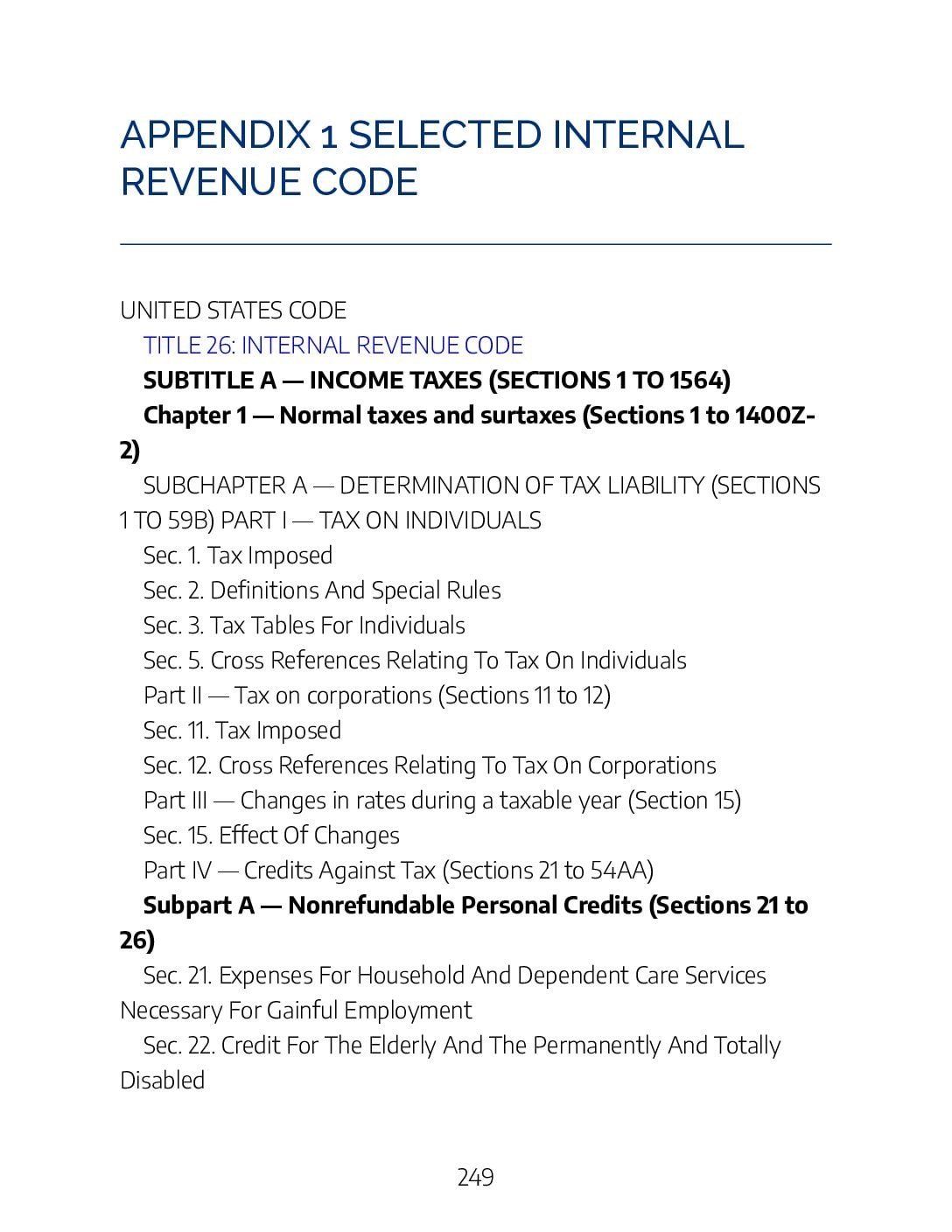
The Internal Revenue Code is Title 26 of the United States Code, and it is enormous, running to thousands of sections covering everything from individual income tax to estate tax to alcohol excise duties. A student or new practitioner opening the Code for the first time can be overwhelmed simply by its scale. This appendix exists as a navigational reference, a selected outline of the Code’s major divisions and the section numbers that fall within them, so that a researcher can go straight to the right neighborhood of the Code instead of searching blindly. Understanding how the Code is organized is a separate skill from understanding any single provision within it, and it is one of the most practical skills a tax student can build.
Why the Code’s Structure Matters
Tax research almost always starts with narrowing down where in the Code an answer is likely to live. Someone researching a question about a business deduction does not need to look anywhere near the estate tax provisions, and someone researching payroll withholding does not need to search through capital gains rules. Knowing the Code’s structure lets a researcher rule out entire sections of law immediately, which is often more valuable than knowing the answer to any single question, because the same navigational skill applies to every new question that comes up.
The structure also matters because related rules are grouped together on purpose. When a provision about itemized deductions is unclear, the surrounding sections in the same Part are usually a good place to look for related definitions, exceptions, or cross-references. The Code’s organization is not arbitrary; it reflects decades of legislative drafting that groups similar tax concepts near each other.
Title, Subtitle, and Chapter: The Top of the Hierarchy
At the broadest level, the Code is a single Title, Title 26. Below that, it is divided into Subtitles, identified by letters, each covering a major category of federal tax: Subtitle A covers income taxes, Subtitle B covers estate and gift taxes, Subtitle C covers employment taxes, Subtitle D covers miscellaneous excise taxes, Subtitle E covers alcohol, tobacco, and certain other excise taxes, and further subtitles cover procedure and administration, the Joint Committee on Taxation, and several other specialized areas.
Within a Subtitle, the next level down is the Chapter. Subtitle A, for example, contains Chapter 1 (normal taxes and surtaxes, which is where the bulk of income tax law lives), Chapter 2 (self-employment tax), Chapter 2A (the unearned income Medicare contribution), Chapter 3 (withholding on nonresident aliens and foreign corporations), and several more. A researcher who identifies the right Chapter has usually narrowed a multi-thousand-section Code down to a manageable few hundred sections.
Subchapters, Parts, and Individual Sections
Below Chapter, the Code divides further into Subchapters, identified by letters, and then into Parts, identified by Roman numerals. Chapter 1’s Subchapter A, for instance, covers the determination of tax liability and contains Part I (tax on individuals), Part II (tax on corporations), Part IV (credits against tax), and Part VI (the alternative minimum tax), among others. Subchapter B covers the computation of taxable income and contains the Parts that define gross income, exclusions from gross income, deductions, and items that are not deductible.
The individual Section is the actual unit of law that gets cited and applied. Sections are numbered sequentially within their Subtitle, which is why Section 61 (the definition of gross income) sits in Subchapter B while Section 1 (the tax imposed on individuals) sits in Subchapter A, even though both are in the same Chapter. When new provisions are added between existing sections, they typically get a letter suffix, such as Section 25A or Section 199A, rather than renumbering everything that follows.
Reading a Section Number and Spotting Repealed Provisions
A citation like Section 179D refers to a specific, addressable provision: Section 179 covers electing to expense certain depreciable business assets, and the D suffix marks a related but distinct provision, in this case the energy efficient commercial buildings deduction, added later without disturbing the original Section 179 numbering. Recognizing this pattern helps a researcher understand that Sections 45A through 45T, for example, are a family of related business tax credits added over time within the same numbering neighborhood.
Tax outlines and code compilations also flag sections that have been repealed, meaning Congress removed the substantive rule but left the section number and title in place as a historical marker, sometimes because other parts of the Code still cross-reference the old number. A researcher who sees a section marked repealed should not treat it as current law, but should also not be surprised to see it listed, since removing a number entirely would break cross-references throughout the rest of the Code.
The Major Subtitles at a Glance
Subtitle A, income taxes, is by far the largest and the one most tax courses and this appendix focus on, since it governs how individuals, corporations, estates, and trusts are taxed on income. Subtitle B, estate and gift taxes, governs the transfer tax system that applies when wealth passes at death or by gift. Subtitle C, employment taxes, governs Social Security, Medicare, and unemployment tax obligations tied to wages.
Subtitle D covers a range of miscellaneous excise taxes, Subtitle E covers taxes specific to alcohol, tobacco, and firearms, and Subtitle F, procedure and administration, is where the rules about audits, penalties, and taxpayer rights discussed elsewhere in this course actually live in the Code, rather than in Subtitle A alongside the substantive income tax rules.
Why Subtitle A Dominates Most Tax Courses
Most introductory and even advanced tax courses spend the overwhelming majority of their time in Subtitle A because it governs the tax that affects the largest number of taxpayers and transactions: what counts as income, what can be deducted, how gain and loss on property are computed, and what credits are available. Subchapters C, K, and S within Subtitle A separately govern corporations, partnerships, and S corporations, which is why a course on business entity taxation draws heavily on this one Subtitle even while covering very different kinds of businesses.
This concentration is also why a selected outline like this appendix is so useful: rather than listing every section in all eleven Subtitles, it can focus a student’s attention on the Parts and Sections of Subtitle A that come up constantly in practice, while still showing where the other Subtitles sit for the rarer occasion when a question strays outside income tax.
Using This Appendix as a Reference Tool
The practical use of an outline like this one is not to memorize it, but to build a mental map good enough that, when a new question comes up, the researcher has a starting guess about where in the Code to look. Over time, repeated exposure to the same Parts and Subchapters through coursework and practice turns that starting guess into genuine familiarity, at which point the outline becomes less necessary for the sections used most often and remains useful mainly for the unfamiliar corners of the Code.
It is worth pairing this structural map with an actual, current copy of the Code (available through the Office of the Law Revision Counsel or a commercial tax service) rather than relying on the outline alone, since the outline shows organization, not the current text of any section, and the Code is amended frequently enough that section content can change even when the numbering stays the same.
Common Navigation Mistakes to Avoid
A common mistake is assuming that because a topic feels procedural, such as penalties or deadlines, it must be near the substantive rules it relates to; in fact, most procedural and administrative rules are grouped separately in Subtitle F rather than alongside the income tax rules in Subtitle A. Another common mistake is treating a section’s title as a complete description of its content; many sections cover more than their short title suggests, and important exceptions or definitions are often found in a different, cross-referenced section entirely.
A third mistake is stopping at the first section that seems relevant without checking nearby sections in the same Part, since related definitions, limitations, and effective-date rules are frequently placed in adjacent sections rather than repeated inside the section being researched. Building the habit of skimming the whole Part, not just the one section, catches these connections much more reliably than section-by-section searching.
Quick revision summary
The Internal Revenue Code (Title 26) is organized top-down as Subtitle, Chapter, Subchapter, Part, and then individual Section.
Subtitle A (income taxes) is the largest subtitle and the primary focus of most tax courses; Subtitles B through K cover estate/gift, employment, excise, and procedural rules.
A letter-suffixed section (e.g., 45A, 199A) is a related provision added later without renumbering the surrounding Code.
A section marked repealed keeps its number as a placeholder so existing cross-references elsewhere in the Code stay intact.
Procedural rules like audits and penalties live in Subtitle F, separate from the substantive income tax rules in Subtitle A.
Always check the Parts and sections surrounding a provision, since related definitions and exceptions are often placed nearby rather than repeated in the section itself.
An IRS audit is simply a review of a taxpayer’s return or supporting financial records to confirm that income, deductions, and credits were reported correctly and that the right amount of tax was paid. Most audits never involve a face-to-face meeting; many are resolved entirely by mail. Alongside the audit function, the IRS also has broad authority to impose penalties on taxpayers who fail to comply with filing, payment, or reporting rules. Understanding how returns get chosen for examination, what the audit process looks like, and which penalties apply in which circumstances helps a taxpayer respond correctly rather than out of fear.
How Returns Get Selected for Audit
The IRS uses several distinct methods to decide which returns to examine. Some returns are chosen through random selection and computer screening, where a statistical sample helps the IRS track broader compliance trends and scoring programs flag returns with a high probability of error based on historical data. A second method is information matching, where the IRS compares what a taxpayer reported against third-party data it independently receives, such as wages on a Form W-2, interest on a Form 1099-INT, or dividends on a Form 1099-DIV; a mismatch between these sources is one of the most common audit triggers.
A third method is the related-examination trigger: if the IRS is already auditing a business partner, investor, or other related party, it may extend the examination to a taxpayer connected to that return. None of these methods require any wrongdoing on the taxpayer’s part; being selected for audit is not itself an accusation, and a large share of audits close with no change to the return at all.
The Three Types of Audits
A correspondence audit is the most common type and is handled entirely by mail. The IRS sends a letter asking for documentation on a small number of specific items, and the taxpayer generally responds by mailing back the requested records. An office audit is more involved: the taxpayer is asked to meet an IRS auditor at an IRS office on a scheduled date to go over a broader range of items than a typical correspondence audit covers.
A field audit is the least common and generally the most complex, involving an IRS auditor visiting the taxpayer’s home, place of business, or accountant’s office. Field audits are usually reserved for businesses or higher-income individuals whose returns involve more moving parts than a correspondence or office audit can efficiently handle.
Stages of the Audit and Taxpayer Rights
The audit process starts with notification: the IRS mails the taxpayer notice of which tax year is being examined and which type of audit will be used. From there the auditor requests documentation and explanations for the specific items under review, and the taxpayer is expected to respond in a reasonably timely way. Throughout this process taxpayers retain specific rights: the right to representation by an attorney, CPA, enrolled agent, or other authorized representative who can deal with the IRS directly on the taxpayer’s behalf; the right to audio-record an in-person interview, provided advance notice is given (the IRS has the same right in reverse); and the right to appeal if the taxpayer disagrees with the findings.
An audit concludes in one of three ways. A no-change outcome means the IRS accepts the return exactly as filed. An agreed-change outcome means the IRS proposes an adjustment and the taxpayer agrees, typically signing a form and paying the additional tax, interest, and any penalty due. A disagreed-change outcome means the IRS proposes an adjustment the taxpayer does not accept, which moves the case into the appeals track described next.
Disagreed Audits: The 30-Day and 90-Day Letters
When a taxpayer disagrees with an audit’s findings, the IRS issues a 30-day letter, formally called a Notice of Proposed Adjustment. This letter details the proposed changes and gives the taxpayer 30 days to file an appeal, which is handled by the IRS Independent Office of Appeals, a body kept separate from the division that conducted the original audit so the review is genuinely independent.
If the taxpayer does not appeal within that window, or disagrees with the outcome of the appeal, the IRS sends a 90-day letter, officially the Notice of Deficiency. This is the IRS’s final determination of the amount owed, and it gives the taxpayer 90 days to petition the U.S. Tax Court to challenge the determination before any tax is formally assessed or collection begins. Letting the 90-day window pass without action generally means the proposed deficiency becomes final and collectible.
Accuracy-Related Penalties Under Section 6662
IRC Section 6662 imposes a penalty, generally 20% of the underpayment, for several categories of error. Negligence or disregard of rules covers a careless, reckless, or intentional failure to make a reasonable effort to comply with the tax law, including inadequate recordkeeping or a general lack of ordinary care in preparing the return. A substantial understatement of income tax applies when the understatement exceeds the greater of 10% of the tax required to be shown on the return or a fixed dollar floor (currently $5,000 for most individual filers, $10,000 for most corporations other than S corporations or personal holding companies).
A valuation misstatement penalty applies when a taxpayer overstates the value or basis of property to inflate a deduction, or understates the value of property or services in a way that reduces reported tax; the rate can rise to 40% for a gross valuation misstatement, reflecting how much more serious that error is treated compared with an ordinary miscalculation.
Failure-to-File and Failure-to-Pay Penalties
IRC Section 6651(a)(1) penalizes filing a return late: 5% of the unpaid tax for each month or partial month the return is late, capped at 25% of the unpaid tax. If a return is more than 60 days late, a minimum penalty applies, set at the smaller of a fixed dollar amount (indexed periodically, $485 for returns due in 2024) or 100% of the tax required to be shown on the return. The penalty does not apply if the taxpayer can demonstrate reasonable cause for the delay.
IRC Section 6651(a)(2) penalizes failing to pay tax that was actually shown on a timely filed return: 0.5% of the unpaid tax per month or partial month, also capped at 25%. This penalty can likewise be avoided with reasonable cause, provided the taxpayer pays the tax as soon as they reasonably can. A related penalty under Section 6656 applies specifically to businesses that are late depositing employment taxes, with the rate stepping up from 2% for a short delay to 15% for a deposit still outstanding after a delinquency notice.
Fraud Penalties: Civil and Criminal
Fraud penalties are reserved for cases where the IRS concludes a taxpayer intentionally tried to evade or defeat the tax owed, and they are far more severe than the accuracy-related penalties. Civil fraud under Section 6663 adds a penalty of 75% of the underpayment attributable to the fraud, on top of the underlying tax and any applicable interest.
Criminal fraud under Section 7201 and related provisions goes further, exposing a taxpayer to prosecution that can result in fines, imprisonment, or both, separate from the civil penalty. Filing a knowingly false return, concealing income, and destroying records are the kinds of conduct that typically support a criminal fraud case rather than a simple accuracy dispute.
Reasonable Cause Relief and Other Considerations
IRC Section 6664(c) provides an exception to the accuracy-related penalties where the taxpayer had reasonable cause for the underpayment and acted in good faith. Whether reasonable cause exists is determined case by case, weighing all the surrounding facts rather than applying a fixed test, which means the taxpayer generally has to document the circumstances that led to the error to support the claim.
Beyond penalties, interest also accrues automatically on any underpayment from the original due date until the tax is paid, at a rate the IRS adjusts periodically; the IRS pays interest the other way on overpayments as well. Separately, the IRS imposes penalties under Section 6721 for failing to file correct information returns, such as Forms 1099 or W-2, or for failing to furnish correct statements to recipients, with the amount generally scaled to how late the filing is and whether the failure was intentional.
Quick revision summary
Returns are selected for audit through random screening, information matching against third-party forms, or related-party examinations.
The three audit types are correspondence (by mail), office (in-person at an IRS office), and field (at the taxpayer’s location), increasing in complexity.
Taxpayers have the right to representation, to record an interview with notice, and to appeal a disagreed finding.
A disagreed audit moves through a 30-day letter (appeal within the IRS) and, if unresolved, a 90-day Notice of Deficiency giving 90 days to petition Tax Court.
Accuracy-related penalties under Section 6662 are generally 20% of the underpayment for negligence, substantial understatement, or valuation misstatement.
Failure-to-file (5%/month) and failure-to-pay (0.5%/month) penalties can both be avoided with reasonable cause; fraud penalties (75% civil, criminal exposure) apply only to intentional evasion.
A tax professional occupies a position of real trust, standing between an individual taxpayer and a complex, high-stakes system of federal law. That position carries both ethical obligations, which govern how a preparer should behave as a matter of professional character, and legal duties, which govern how a preparer must behave as a matter of enforceable rule. The single most important source of those legal duties is Treasury Department Circular 230, the regulation that governs anyone who practices before the IRS. Understanding where ethics ends and enforceable regulation begins is essential for anyone entering tax practice.
Core Ethical Principles for Tax Professionals
Several principles recur across every code of conduct written for tax practitioners. Integrity requires honesty and candor in every dealing with a client, the IRS, and other parties, without shading the truth to make an engagement easier. Objectivity requires the practitioner to keep personal or firm interests from clouding professional judgment, which is why conflicts of interest are treated so seriously. Competence requires staying current with a body of law that changes constantly, since advice based on outdated rules can harm a client even when it is given in good faith.
Confidentiality requires protecting a client’s financial information, a duty that is not just an ethical norm but is also backed by law under IRC Section 7216, which can carry criminal penalties for improper disclosure of return information. Due care requires the diligence and thoroughness to get the technical work right, not just the intention to do so. Together these principles describe the character a tax practice is supposed to have, even before any specific regulation is consulted.
Legal Duties Beyond Ethics
Beyond these general principles, tax professionals carry duties that are directly enforceable. The most basic is compliance with tax law itself: preparing and filing accurate returns and giving advice consistent with the law as it actually stands. In some client relationships a preparer also owes a fiduciary duty, meaning they must act in the client’s best interest with the utmost good faith, a higher standard than an ordinary arm’s-length business relationship.
Practitioners also have a duty to avoid situations where one client’s interests conflict with another’s, or with the practitioner’s own interests, and a duty to maintain adequate records of the services provided. Due diligence appears again here as a legal, not just ethical, requirement, particularly when a preparer signs a return or gives written advice that a client will rely on.
Circular 230: Purpose and Structure
Circular 230, found at 31 CFR Part 10, is the regulation that governs attorneys, CPAs, enrolled agents, enrolled retirement plan agents, enrolled actuaries, and appraisers who practice before the IRS. Its purpose is to protect the integrity of the tax system by setting minimum standards of conduct for anyone representing a taxpayer, whether that representation involves preparing documents, communicating with the IRS, giving written tax advice, or handling an audit or appeal.
The regulation is organized into subparts. Subpart A defines who is authorized to practice before the IRS and the requirements for enrollment. Subpart B, the largest and most consequential part, sets out the specific duties and restrictions practitioners must follow. Subpart C describes the sanctions the IRS can impose for violations, and Subpart D lays out the procedure for disciplinary proceedings against a practitioner accused of violating the rules.
Key Duties Under Circular 230, Subpart B
Several sections of Subpart B come up constantly in practice. Section 10.22 requires diligence as to accuracy: a practitioner must exercise due diligence in preparing returns and other documents, not simply pass along whatever a client provides. Section 10.21 requires promptly furnishing information the IRS has lawfully requested, and Section 10.23 requires not unreasonably delaying a matter pending before the IRS.
Section 10.28 requires a practitioner to promptly return a client’s records so the client can meet their own tax obligations, even if a fee dispute is unresolved. Section 10.29 requires declining or withdrawing from an engagement where a genuine conflict of interest exists, unless each affected client gives informed, written consent. Section 10.34 sets the substantive standard for advising on and preparing returns, generally requiring a reasonable basis for any position taken, and Section 10.37 sets detailed requirements for written advice, including considering all the relevant facts and reaching a conclusion that the law actually supports.
IRC Preparer Penalties
Separate from Circular 230’s own enforcement, the Internal Revenue Code imposes direct monetary penalties on return preparers. IRC Section 6694 penalizes a preparer when a return position produces an understatement of tax: a lower-tier penalty applies where the position lacked a reasonable basis, or, for a position requiring disclosure, lacked substantial authority, while a materially higher-tier penalty applies where the preparer’s conduct in taking the position was willful or reckless.
IRC Section 6695 imposes smaller, more procedural penalties for failures such as not signing a return the preparer completed, not furnishing a copy to the taxpayer, or not retaining the records the law requires a preparer to keep. These IRC penalties are independent of Circular 230 sanctions and can apply on top of them, so a single serious lapse can expose a practitioner to a monetary penalty from the IRS and separate disciplinary action under Circular 230.
Sanctions for Violating Circular 230
Subpart C of Circular 230 authorizes several levels of sanction depending on the severity of the violation. Censure is a formal public reprimand that does not remove the practitioner’s ability to practice. Suspension removes that ability for a defined period, and disbarment removes it indefinitely, effectively ending the practitioner’s ability to represent clients before the IRS.
Beyond the sanctions written into Circular 230 itself, a serious violation can trigger consequences from other authorities entirely: state licensing boards can revoke a CPA license or bar admission for an attorney, intentional misconduct can lead to criminal charges, and a client harmed by negligent or dishonest advice can bring a civil lawsuit. The reputational cost of a public disciplinary action is often the most lasting consequence, since it affects a practitioner’s ability to attract and keep clients long after any formal sanction has ended.
Common Ethical Dilemmas and How Standards Resolve Them
Certain situations recur often enough in practice that professional standards address them directly. When a client pressures a preparer to take an aggressive position that lacks adequate legal support, Circular 230 Section 10.34 and IRC Section 6694 both require the position to clear a minimum threshold before it can be taken, and the preparer must be willing to decline to sign a return that does not meet it. When a preparer discovers a significant error on a client’s previously filed return, confidentiality prevents notifying the IRS without permission, but Section 10.21 still requires promptly telling the client about the error and its consequences and refusing to carry the same error forward on future returns.
When client-provided information looks incomplete or inconsistent, the due diligence duty in Section 10.22 requires making reasonable inquiries rather than accepting the numbers at face value, and declining the engagement if the client cannot resolve the inconsistency. When representing one client would work against another client’s interests, Section 10.29 generally requires declining or withdrawing unless every affected client gives informed written consent and the practitioner reasonably believes competent service can still be provided to each. In every one of these situations, the resolution comes from applying a known, written standard rather than from the practitioner’s personal judgment alone, which is exactly what gives Circular 230 its force.
Quick revision summary
Ethical principles for tax practice include integrity, objectivity, competence, confidentiality, and due care.
Legal duties go beyond ethics and include compliance with tax law, fiduciary duty in some relationships, and avoiding conflicts of interest.
Circular 230 (31 CFR Part 10) governs anyone who practices before the IRS, including attorneys, CPAs, and enrolled agents.
Subpart B sections such as 10.21, 10.22, 10.28, 10.29, 10.34, and 10.37 set the specific duties practitioners must follow.
IRC Sections 6694 and 6695 impose separate monetary penalties on preparers, independent of any Circular 230 sanction.
Violations can lead to censure, suspension, or disbarment under Circular 230, plus possible license revocation, criminal charges, or civil liability.
Tax research is the structured process a tax professional follows to answer a specific question about how the tax law applies to a particular set of facts. Because the Internal Revenue Code, Treasury regulations, IRS guidance, and court decisions all interact, a single question rarely has its answer sitting in one place. A researcher has to locate the relevant authorities, judge how much weight each one carries, and apply that authority to the facts at hand. Getting this process right protects a client from paying more tax than the law requires and protects the preparer from giving advice that cannot be defended if it is later challenged.
What Tax Research Involves and Why It Matters
At its core, tax research is problem-solving under uncertainty. The tax code changes every year, agencies issue new guidance, and courts hand down decisions that reinterpret existing rules, so a fact pattern that was settled five years ago may be treated differently today. A practitioner cannot memorize every possible answer; instead, the skill that matters is knowing how to find, evaluate, and apply the authorities that govern a given situation.
Tax research generally falls into two categories. Compliance research happens while a return is being prepared, is usually driven by a filing deadline, and deals with facts that have already occurred and cannot be changed. Planning research happens before a transaction takes place, gives the practitioner more time and more flexibility, and can influence how the transaction is structured so the client achieves a better tax outcome. Both types rely on the same underlying process, but planning research has the added benefit of being able to shape the facts rather than simply interpret them.
The Six-Step Tax Research Process
Most tax research follows a recognizable sequence. First, the researcher establishes the facts, gathering every detail that could affect the tax outcome, since even a small factual difference can change which rules apply. Second, the researcher identifies the issues, translating the facts into specific legal questions that authorities can actually answer. Third, the researcher locates the relevant authority, searching the Internal Revenue Code, regulations, rulings, and case law for material bearing on the issues identified.
Fourth, the researcher evaluates the authority that was found, weighing its source, its currency, and whether it still represents the government’s or the courts’ current position. Fifth, the researcher develops a conclusion, integrating the facts and the authority into a reasoned answer, including addressing any authority that points the other way. Sixth, the researcher communicates the results, documenting the analysis and conclusion in a form appropriate for the audience, whether that is an internal file memo or a letter to the client.
Communicating Findings: Memo vs. Client Letter
How the results of research are written up depends on who will read them. An internal tax research memo is a technical document meant for the firm’s own files. It states the facts, frames the issues, cites the specific authorities relied upon, and lays out the reasoning that connects the authority to the conclusion. Because it may later be reviewed by a supervisor, an IRS examiner, or a court, the memo should be precise enough that another professional could follow the reasoning and reach the same conclusion.
A client letter serves a different purpose. It translates the technical analysis into plain language the client can act on, states the recommendation clearly, and generally avoids code sections and case citations unless the client specifically wants that level of detail. A well-written client letter states the question, gives the answer, briefly explains the reasoning in everyday terms, and notes any risk or uncertainty the client should be aware of before proceeding.
Primary Authority: Legislative Sources
Legislative authority comes from Congress and stands at the top of the hierarchy because it represents the actual law. The Internal Revenue Code, enacted by Congress and organized as Title 26 of the United States Code, is the single most authoritative source in tax research; everything else exists to interpret or apply it. When the meaning of a Code section is unclear, committee reports from the House Ways and Means Committee, the Senate Finance Committee, or the Joint Committee on Taxation are used to understand what Congress intended when it wrote the provision.
Tax treaties between the United States and other countries are also legislative authority. A treaty can modify how the Code applies to cross-border income, and where a treaty and the Code conflict, the general rule is that the later-enacted provision controls, although treaty relief provisions add their own layer of complexity that has to be checked for the specific countries involved.
Primary Authority: Administrative Sources
Administrative authority comes from the Treasury Department and the IRS and exists to explain how the Code should be applied in practice. Treasury regulations interpret specific Code sections and carry different levels of authority depending on their status: final regulations carry the most weight, temporary regulations are binding but time-limited, and proposed regulations signal the government’s thinking without yet being binding law.
Below regulations sit revenue rulings, which apply the law to a specific, described set of facts and can generally be relied upon by any taxpayer whose facts are substantially the same, and revenue procedures, which explain administrative or procedural requirements a taxpayer must follow. Private letter rulings and technical advice memoranda respond to a specific taxpayer’s request and are binding only on that taxpayer, though practitioners still read them to gauge how the IRS is likely to treat a similar situation.
Primary Authority: Judicial Sources
When a dispute between a taxpayer and the IRS cannot be resolved administratively, it moves to the courts, and court decisions become primary authority in their own right. A taxpayer can choose to litigate in the U.S. Tax Court without first paying the disputed tax, in a U.S. District Court, or in the U.S. Court of Federal Claims, both of which require the tax to be paid first, and each forum has its own procedural advantages depending on the case.
Decisions from these trial-level courts can be appealed to the U.S. Circuit Courts of Appeals, and from there to the U.S. Supreme Court, though the Supreme Court hears very few tax cases each year. Because the Tax Court hears cases from taxpayers across the country, it generally follows the precedent of the circuit court to which a given case would be appealed, a practice known as the Golsen rule, which means the same legal question can technically have different answers depending on the taxpayer’s home circuit until the Supreme Court resolves the conflict.
Secondary Authorities and IRS Publications
Secondary sources do not carry the force of law, but they are often where research actually begins because they explain complicated primary authority in a more digestible form and point the researcher toward the specific primary sources that matter. Commercial tax services, treatises, and law review or journal articles fall into this category. They are useful for building an understanding of an issue quickly, but a conclusion should never rest on a secondary source alone.
IRS Publications, such as Publication 17 for individual income tax or the many topic-specific publications the IRS produces, are also secondary authority. They are written for general taxpayer guidance, are easier to read than the Code or regulations, and are a reasonable starting point for understanding an issue, but courts have consistently held that a taxpayer cannot rely on an IRS Publication as legal authority if it turns out to be wrong or incomplete, so any position taken on a return should ultimately trace back to a primary source.
Citing Tax Authorities Correctly
A citation exists so that another reader can locate the exact authority being relied upon, so the format matters as much as the substance. The Internal Revenue Code is typically cited by section number, for example IRC Section 61, sometimes written as Section 61 or IRC Sec. 61 depending on house style. Treasury regulations are cited with a prefix identifying the type of tax they address, followed by the Code section they interpret, such as Treas. Reg. Section 1.61-1 for an income tax regulation under Section 61.
Revenue rulings and revenue procedures are cited by year and number, such as Rev. Rul. 2023-14 or Rev. Proc. 2023-1. Court cases are cited with the case name, the reporter volume and page or docket number, the court, and the year, for example Smith v. Commissioner, 123 T.C. 45 (2004) for a Tax Court decision. Consistent, accurate citation is what allows a reviewer, a client’s future advisor, or an IRS examiner to check the research and confirm the conclusion was properly supported.
Quick revision summary
Tax research follows six steps: establish facts, identify issues, locate authority, evaluate authority, develop a conclusion, and communicate the results.
Compliance research happens after the fact under a filing deadline; planning research happens before a transaction and allows more flexibility.
Legislative authority (the Internal Revenue Code and treaties) sits at the top of the hierarchy because it is the actual law passed by Congress.
Administrative authority includes Treasury regulations, revenue rulings and procedures, and private letter rulings, each carrying a different level of binding effect.
Judicial authority runs from the Tax Court, District Courts, and Court of Federal Claims up through the Circuit Courts of Appeals to the Supreme Court.
Secondary sources such as tax services, treatises, and IRS Publications are useful starting points but are never a substitute for primary authority.
A taxpayer who sells several pieces of property in the same year does not report each gain or loss in isolation – the amounts have to be netted together in a specific sequence before the final number reaches Form 1040. Business property covered by Section 1231 goes through its own preliminary netting step before joining the broader capital gain and loss calculation, and even within long-term capital gains, different categories of gain can be taxed at different maximum rates. This note walks through the Section 1231 netting rules, the overall short-term and long-term netting process, and the forms that tie it all together.
Section 1231 Property and the Two-Step Netting Process
Section 1231 property covers depreciable and real property used in a trade or business and held for more than a year – machinery, equipment, buildings, and similar business assets. All gains and losses from Section 1231 property disposed of during the year are netted together first. If that net result is a gain, the entire amount is treated as long-term capital gain, giving the taxpayer access to preferential rates on what is, in substance, business property. If the net result is a loss, it is treated as an ordinary loss, fully deductible against ordinary income without the limitations that apply to capital losses – a more favorable outcome for a net loss than ordinary capital loss treatment would provide.
The Section 1231 Look-Back Rule
Because netting a gain into capital treatment and netting a loss into ordinary treatment is more favorable in both directions than treating Section 1231 property as an ordinary capital asset would be, the Code includes a guardrail. Under the Section 1231 look-back rule, a current-year net Section 1231 gain is treated as ordinary income, not capital gain, to the extent of any net Section 1231 losses claimed as ordinary losses in the preceding five years that have not yet been recaptured this way. The rule stops a taxpayer from taking an ordinary loss deduction in one year and then converting a later gain into lower-taxed capital gain without ever giving back the earlier benefit.
Netting Short-Term and Long-Term Amounts
Once any net Section 1231 gain has been folded in as long-term capital gain, the overall capital gain and loss netting process begins. All short-term gains and losses – from assets held one year or less – are combined first, producing either a net short-term gain or a net short-term loss. All long-term gains and losses, including the net Section 1231 gain if there is one, are combined separately, producing a net long-term gain or loss. If one category shows a gain and the other shows a loss, the loss offsets the gain: a net long-term loss offsets a net short-term gain, or a net short-term loss offsets a net long-term gain, leaving a single overall net capital gain or net capital loss.
The Capital Loss Limit and Carryforward
If the netting process ends in an overall capital loss, only a limited amount can be deducted against ordinary income in the current year, with any remainder carried forward indefinitely to future years, where it can offset future capital gains and, again, a limited amount of ordinary income each year. A net short-term capital gain, unlike long-term gain, is simply taxed at the same rates as ordinary income – the preferential rate structure applies only to the long-term category.
Different Rates Within Long-Term Capital Gain
Not every dollar of long-term capital gain is taxed the same way. General long-term gains from stocks, bonds, and most investment property qualify for the standard preferential rates. Gains from collectibles such as art, antiques, and coins are capped at a higher maximum rate than general long-term gains, reflecting their character as much personal property as investment. Unrecaptured Section 1250 gain, representing depreciation taken on real property that was not subject to full ordinary-income recapture, carries its own maximum rate between the general long-term rate and the collectibles rate. A portion of gain on qualifying small business stock held long enough can be excluded entirely, with the non-excluded remainder capped at its own maximum rate. Qualified dividends, while not gains from a sale at all, are taxed at the same preferential rates as general long-term capital gain.
How Capital Gains Stack on Top of Ordinary Income
Net long-term capital gain does not exist in a vacuum for rate purposes – it is layered on top of ordinary income after ordinary income has already filled the lower brackets. The rate that applies to any given portion of the capital gain depends on where total taxable income, ordinary income plus the gain itself, lands relative to the capital gains rate breakpoints, which means the same dollar of gain can be taxed differently depending on how much ordinary income the taxpayer also has that year.
The Forms That Report It All
Form 4797 reports the sale of Section 1231 and other business property and is where the initial Section 1231 netting happens; a resulting net gain flows to Schedule D, while a net loss is reported as ordinary income. Form 8949 lists the details of each individual sale of a capital asset, both short-term and long-term, and its totals flow into Schedule D. Schedule D performs the final netting of everything – the Form 8949 totals plus any net Section 1231 gain from Form 4797 – to arrive at the overall net capital gain or loss that ultimately lands on Form 1040.
Quick revision summary
Section 1231 gains and losses are netted first: a net gain is treated as long-term capital gain, and a net loss is treated as a fully deductible ordinary loss.
The Section 1231 look-back rule recharacterizes a current-year net gain as ordinary income to the extent of unrecaptured Section 1231 losses from the prior five years.
After Section 1231 netting, all short-term and all long-term capital gains and losses are separately netted, and a loss in one category offsets a gain in the other.
Only a limited amount of net capital loss is deductible against ordinary income each year, with the rest carried forward indefinitely.
Long-term capital gain is not taxed at one uniform rate – collectibles gain, unrecaptured Section 1250 gain, and qualified small business stock gain each carry their own maximum rate.
Capital gains are taxed as if stacked on top of ordinary income, so the applicable rate depends on total taxable income, not the gain in isolation.
Form 4797 handles Section 1231 netting, Form 8949 lists individual capital asset sales, and Schedule D performs the final netting reported on Form 1040.