Explains fundamental discrete structures including sets (unordered collections), functions (mappings between sets), sequences (ordered lists), relations, and graphs. Uses set builder notation, natural numbers, and introduces closed versus recursive function definitions with examples.
Introduces discrete mathematics concepts through problem-solving approach. Covers handshake problems, sequences, logic puzzles, and graph theory basics. Emphasizes understanding discrete structures (individually separate and distinct mathematical objects) versus continuous mathematics.
Comprehensive chapter review of counting techniques including Pascal’s triangle, sum/product principles, permutations, combinations, stars and bars, PIE, and combinatorial proofs. Contains extensive practice problems integrating all counting methods with solutions strategies.
Advanced counting problems using Principle of Inclusion-Exclusion for multiple sets. Covers derangements (permutations with no fixed points), counting surjective functions, distributing distinguishable objects, and solving complex overlap problems.
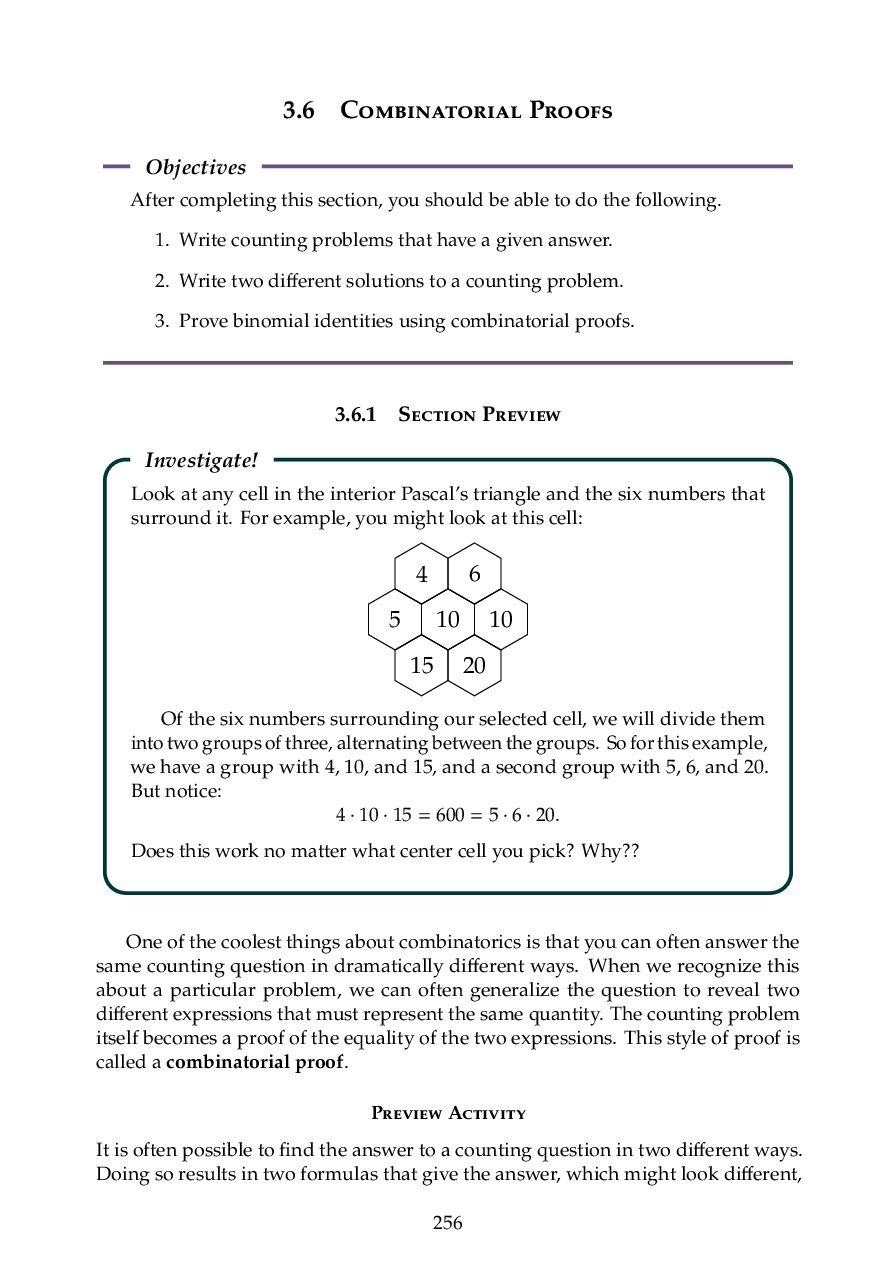
Explores combinatorial proof techniques using bijections and double counting. Shows how to prove binomial identities by counting the same set in two different ways. Includes Pascal’s identity, subset selection proofs, and bijective correspondences.