
Introduction
Most students revise by reading their notes again. It feels productive, and then the exam asks a question and the answer is not there. The problem is rarely effort. Recognition and recall are different skills, and rereading trains only the first. Two methods close that gap, and cognitive psychologists rate them above every other technique students commonly use.
What the Evidence Shows
Practice Testing and Distributed Practice Rank Highest: In 2013, Dunlosky, Rawson, Marsh, Nathan and Willingham reviewed ten common study techniques for Psychological Science in the Public Interest. Only two earned a high utility rating, meaning they worked across ages, subjects and ability levels: practice testing and distributed practice.
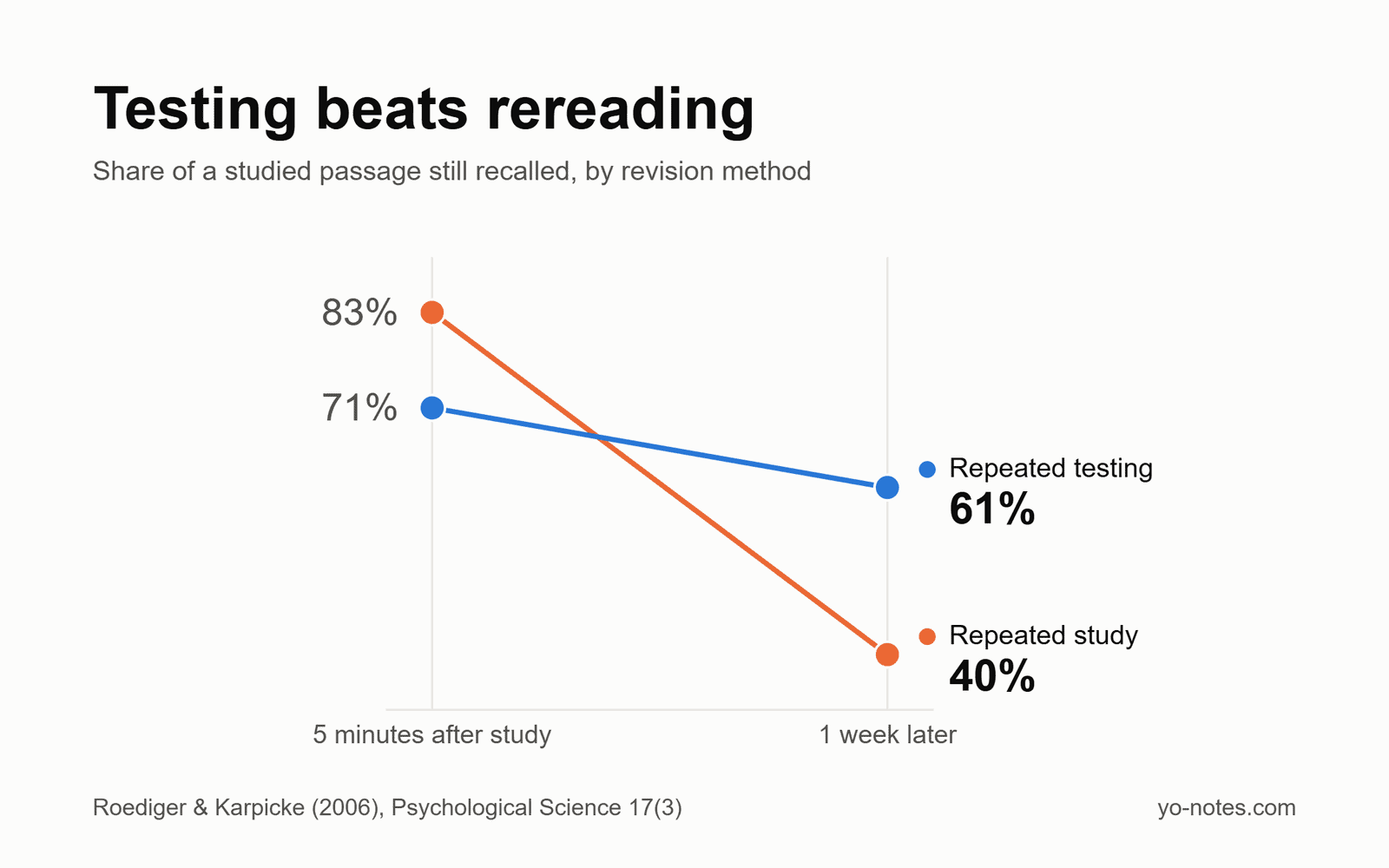
The One-Week Gap Is Large: Roediger and Karpicke tested this in 2006. Students read prose passages and either studied them again or took recall tests. Five minutes later the restudy group looked better, 83 per cent against 71 per cent. One week later the ranking reversed: 40 per cent for restudy, 61 per cent for repeated testing.
Forgetting Slows, Not Just Recall Improves: Over that week the restudy group lost more than half of what it had gained. The tested group lost about a seventh. Testing did not simply add a few marks. It changed how fast the material drained away.
Retrieval Beats More Elaborate Methods: Karpicke and Blunt put retrieval practice against concept mapping in Science in 2011, a far more effortful technique. Retrieval practice still produced more learning.
Popular Methods Score Poorly: Rereading, highlighting and underlining, summarisation and keyword mnemonics were all rated low utility in the same 2013 review. Interleaved practice, elaborative interrogation and self-explanation landed in the middle.
What Active Recall Actually Means
Produce, Then Check: Active recall means closing the book, producing the answer from memory, and only then checking whether you were right. Producing builds the memory. Checking keeps you honest. Both steps are required.
Not Rereading, Not Highlighting: If the answer is visible while you work, you are studying, not recalling. Copying notes into a neater book fails the same test. An exam will not keep the answer in front of you.
The Discomfort Is the Mechanism: Rereading feels smooth and recall feels hard, and students read that difficulty as failure. The 2006 data explains the trap. Restudying does win immediately, by twelve percentage points, but the advantage does not survive a week, and exams are not written the same afternoon you study.
Turning Your Notes Into Questions
Write Questions the Same Day: Convert the chapter into questions right after you first read it, while you still know which parts mattered. Questions written a month later tend to follow only what you already remember.
Use Four Question Types: Definitions, for what you simply have to know. Process questions, where you lay out a sequence or a derivation. Comparison questions, which force you to hold two ideas apart. Application questions, where a small change in the setup changes the answer.
Try the Blank Page Method: Write the topic name at the top of a sheet and put down everything you can remember without looking. Open your notes, mark what you missed in another colour, and revise only the coloured parts.
Bring In Past Papers Early: Past papers are the highest quality retrieval practice available, because they carry the wording of the examiner. Use them earlier than feels comfortable, not only in the final month.
Spacing Your Revisions
Gap and Delay Work Together: Cepeda, Pashler, Vul, Wixted and Rohrer synthesised 839 assessments from 317 experiments across 184 articles in 2006. The best gap between study sessions grows as the test moves further away.
Around 10 to 20 Per Cent of the Time Remaining: A 2008 study by the same group tested 1,354 participants across gaps of 0 to 105 days and delays of 7, 35, 70 and 350 days. For delays of a few weeks the optimal gap was roughly 10 to 20 per cent of the time until the test, falling to about 5 per cent at one year.
Translating It Into a Plan: This next step is an inference from the research rather than a finding of it, but the arithmetic is simple. An exam thirty days away suggests revisiting each topic every three to six days. Six months away suggests every two to four weeks. A year away suggests roughly every three weeks.
Run Four Passes Per Topic: Day 0, learn the topic and write the questions. Day 2, first recall round from memory, then check. Day 7, second round. Day 21, third round. Gaps measured in days and weeks, never compressed into one night.
Carry Forward Only the Gaps: Mark each question solid, shaky or blank. Only shaky and blank items travel to the next round, so the list shrinks each pass. If a topic still produces blanks by the third round, the explanation has not landed and rereading will not fix it.
Mistakes That Waste the Method
Making a Question for Every Line: Aim at the ideas an examiner can build a question on, not the full text of the chapter.
Practising Only What You Know: It feels good and teaches nothing. The blanks are the entire point of the method.
Rewriting Notes and Calling It Revision: Neat notes are a product, not a process. Time spent copying is time not spent retrieving.
Saving All Recall for the Last Week: That is cramming with extra steps, and it removes the spacing that does half the work.
Skipping the Check: Recall without verification will cement a wrong answer as firmly as a right one.
Conclusion
Nothing here asks for new material or more hours. It asks you to close the book earlier than feels comfortable, write questions on the day you learn a topic, and spread the rounds across weeks instead of stacking them the night before. The evidence for both habits is old, large and consistent. The hard part is only that the better method feels worse while you are doing it.