Bank exam preparation usually begins with whichever subject feels most urgent. Any IBPS PO preparation strategy faces the same problem an SBI one does: four subjects, two written stages and a limited number of weeks. The State Bank of India advertisement for its 2026 Probationary Officer recruitment sets out those stages precisely, and reading them first settles most of the sequencing questions.
What the Two Phases Are For
Preliminary Marks Do Not Carry Forward: The State Bank advertisement for the 2026 Probationary Officer recruitment states that marks obtained in the Preliminary Examination will not be added when preparing the final merit list. Phase 1 decides who continues, and nothing beyond that.
Where the Selection Actually Happens: The same advertisement normalises Phase 2 to 75 points and Phase 3, the group exercise and interview, to 25 points, giving 100 in total. The written main paper is three quarters of the outcome.
Two Papers, Different Shapes: Phase 1 runs 100 questions for 100 marks in one hour. Phase 2 runs 170 objective questions for 200 marks across three hours, followed by a descriptive paper of 30 marks in 30 minutes. Speed is tested in the first, depth in the second.
Read the IBPS Notification Separately: The Institute of Banking Personnel Selection runs its own Common Recruitment Process for probationary officers and management trainees, currently in its sixteenth cycle, with a notification issued in July 2026 and corrigenda after it. Its pattern is set in that notification, not by the State Bank, and it should be read directly.
The Preliminary Paper Is a Speed Filter
Twenty Minutes Per Section: Phase 1 gives English Language 40 questions, Quantitative Aptitude 30 and Reasoning Ability 30, with 20 minutes for each. Time cannot be moved between sections, so a strong subject cannot be used to rescue a weak one.
The Question Rate Is Not Even: Forty English questions in 20 minutes allows 30 seconds each. Thirty quantitative questions in the same window allows 40. English carries the highest question rate of the three sections, which is worth knowing before the clock starts.
Every Wrong Answer Costs a Quarter: The advertisement sets a penalty of one fourth of the marks assigned to a question for each wrong answer. That ratio holds whatever a section is marked out of, so the decision to attempt or leave a question does not change between the two phases.
Practise Against the Clock: A candidate who can finish a set in 30 minutes but not in 20 has not yet prepared for this paper. Sectional timing is the actual constraint, and untimed practice leaves it untested.
Sequencing the Four Subjects
Awareness Rewards Early and Regular Work: General awareness with economy and banking knowledge carries 60 questions in the main objective paper, the largest block of the four tests. Recall of that kind accumulates over months, which argues for starting it first. That ordering follows from the structure rather than from any instruction in the advertisement.
Two Subjects Carry the Marks: Reasoning with computer aptitude and data analysis with interpretation are marked at 60 each in the main paper. The weighting favours building method in those two over spreading hours evenly across all four.
English Is Weighted Differently at Each Stage: English has the most questions of the three preliminary sections, while in the main objective paper it carries 40 questions for 20 marks, the smallest allocation of the four. The same subject is worth different things at each stage.
The Descriptive Paper Is Separate Work: Phase 2 includes a descriptive test of communication skills worth 30 marks in 30 minutes, covering emails, situation analysis, and report or precis writing. It is not covered by objective practice and needs its own slot.
What the Evidence Says About Practice
Only Two Techniques Rated High: Dunlosky, Rawson, Marsh, Nathan and Willingham reviewed ten study techniques in Psychological Science in the Public Interest in 2013 and placed only practice testing and distributed practice in the high utility band. Rereading, highlighting and summarisation were rated low.
Confidence Is Not Retention: Roediger and Karpicke reported in Psychological Science in 2006 that repeated studying beat repeated testing when recall was measured after five minutes, while prior testing produced substantially greater retention at two days and one week. Restudying raised confidence without matching that retention.
What That Means for Question Sets: Working through a set with the solutions to hand is closer to restudying than to testing. Attempting it cold and checking afterwards is the version the research supports. Applying that to banking question banks is an inference, since the studies used general learning material.
Spacing Suits Awareness Best: Distributed practice, the other high utility technique in that review, means short returns to a topic rather than one long block. The awareness section, with the largest question count in the main paper, is the part of the syllabus that fits the pattern most naturally.
Turning It Into a Week
One Timed Paper: A full preliminary set under sectional timing once a week shows whether the constraint is speed or accuracy. Without the timer, the paper being practised is not the paper that will be sat.
Two Long Blocks for Method: Reasoning with computer aptitude and data analysis with interpretation reward worked method more than volume. Two long blocks a week on those two, with the sets attempted cold, matches how the main paper is marked.
A Short Daily Awareness Slot: Fifteen or twenty minutes on most days for economy and banking awareness accumulates across months. The largest question block in the main paper is also the one least suited to a final push.
One Written Answer a Week: Writing a single email or precis under 30 minutes each week costs little and removes the risk of meeting the descriptive paper cold. Written work also gives feedback that objective practice does not.
Conclusion
The papers describe their own priorities. Phase 1 screens under a fixed 20 minutes a section and its marks do not carry forward, while the main paper and the interview stage decide the list between them. A plan that weights subjects by the marks they carry, tests cold rather than rereads, and keeps awareness running daily is working with that structure rather than against it.
Most candidates begin SSC CGL preparation by picking a subject and studying it until it feels finished. The examination is not built that way. The Commission’s 2026 notice sets out two tiers with different jobs, different penalties for a wrong answer, and only one of them counting towards the final list.
What the Tier Structure Actually Decides
Two Tiers, One Merit List: The Combined Graduate Level Examination 2026 notice states that the merit list for final selection rests on overall performance in the Tier 2 examination only. Tier 1 shortlists candidates category-wise for Tier 2 and stops there.
What That Means for Effort: Tier 1 still has to be cleared, and a weak score ends the attempt. Marks earned above the cut-off carry nothing forward. Treating both tiers as equally weighted spreads effort evenly across a paper that only screens and a paper that decides.
The Shape of Tier 1: The notice lists four subjects at 25 questions and 50 marks each: General Intelligence and Reasoning, General Awareness, Quantitative Aptitude and English Comprehension. That is 100 questions and 200 marks in one hour, with a sectional timer of 15 minutes per subject.
The Shape of Tier 2: Paper 1 sets Mathematical Abilities at 30 questions, Reasoning and General Intelligence at 30, English Language and Comprehension at 45, General Awareness at 25, and a Computer Knowledge Test at 20. Paper 2 in Statistics and Paper 3 in General Studies apply to specific posts only.
Reading Tier 1 as a Speed Test
Fifteen Minutes Per Subject: The sectional timer means time cannot be borrowed. Fifteen minutes for 25 questions works out at 36 seconds each, and a section closes whether or not it is finished. Practice that allows free movement across the full hour trains the wrong habit.
The Guessing Arithmetic: Each Tier 1 question carries 2 marks and each wrong answer costs 0.50. On those numbers the expected value of a four-option guess is positive, so the arithmetic favours attempting over leaving blanks. That calculation is an inference from the published marks, not advice from the Commission.
Tier 2 Penalises Differently: The deduction in Sections 1 to 3 of Tier 2 Paper 1 is 1 mark for each wrong answer, and section marks are scaled by a factor of three. A guessing habit built during Tier 1 practice should be re-examined before it is carried across.
Practise With the Timer On: Full-length attempts under sectional timing show which section runs out of time first. Two timed attempts a week reveal whether the constraint is speed, accuracy or recall.
Building the Plan Backwards From Tier 2
Start From the Paper That Counts: Because merit rests on Tier 2, the depth required there should set the standard for study, and Tier 1 becomes a faster version of the same material. This follows from the structure rather than from any instruction in the notice.
English Carries the Largest Block: English Language and Comprehension has 45 questions in Paper 1, against 30 each for mathematics and reasoning and 25 for general awareness. Postponing English until quantitative aptitude feels secure delays the biggest single module.
Check Whether Paper 2 or 3 Applies: Paper 2 in Statistics is set for Junior Statistical Officer and Statistical Investigator Grade 2 candidates, and Paper 3 in General Studies for Assistant Audit Officer and Assistant Accounts Officer candidates. Settling this early prevents wasted study and a missing subject.
Qualifying Sections Need Regular Slots: The Computer Knowledge Test and the Data Entry Speed Test are qualifying in nature, with a separate higher cut-off where computer proficiency is prescribed. Both are compact enough for short weekly sessions, and typing improves with repetition spread over months.
Testing Beats Rereading
What the Evidence Ranks Highest: Dunlosky, Rawson, Marsh, Nathan and Willingham reviewed ten study techniques in Psychological Science in the Public Interest in 2013 and placed only two in the high utility band: practice testing and distributed practice. Rereading, highlighting and summarisation were rated low utility.
Why Rereading Feels Better Than It Is: Roediger and Karpicke reported in Psychological Science in 2006 that repeated studying beat repeated testing when recall was measured five minutes later, and that testing produced substantially greater retention at two days and one week. Repeated studying raised confidence without matching that retention.
Turning the Syllabus Into Questions: Reading a chapter three times and converting it into thirty questions answered from memory take comparable hours. Only the second leaves a record of what could be retrieved. Applying this to SSC preparation is an inference, since the research used general learning material rather than competitive examinations.
Spacing Over Massing: Distributed practice, the other high utility technique in that review, means returning to a topic after a gap instead of finishing it in one sitting. A topic met in week one and revisited in weeks three and six is spaced; the same hours back to back are not.
A Week That Keeps Every Section Alive
One Long Block and One Short Slot: Four Tier 1 subjects and five Tier 2 modules do not fit sequential study. One long block and one short revision slot per subject each week keeps all of them in circulation, because a section left for a month does not stay ready.
Separate Learning From Retrieval: Two kinds of session are needed: one to meet new material, one to recall it without the book open. Combining them collapses the second into rereading, because the answers sit on the same page.
Analyse the Attempt, Not the Score: A mock test that produces only a number has given up most of its value. Sorting each wrong answer into a knowledge gap, a method error or a timing loss shows what next week should target.
Keep General Awareness Running: General awareness appears in both tiers and rewards accumulated coverage rather than a final push. A short daily slot suits it better than long sessions, and it fits the spacing pattern.
Work From the Notice, Not From Hearsay: The 2026 notice describes approximately 12,256 vacancies and lists Tier 1 as tentatively August to September 2026, with Tier 2 tentatively in December 2026. Schedules move, so the notice and the Commission’s website remain the only dependable source.
Conclusion
The tier structure is public and specific, and it settles most planning questions before a single subject is opened. Tier 1 screens under a sectional timer that cannot be negotiated, and Tier 2 decides the list. A plan that starts from that fact, tests rather than rereads, and returns to topics after a gap is doing the part the evidence supports.
Two students can know the same amount and leave a board exam with different marks. The gap often sits in how the answer was written rather than in what was known. CBSE publishes a marking scheme alongside every sample question paper, which means the standard an examiner works to is public and worth studying before the exam.
Read the Marking Scheme, Not Just the Question Paper
Where to Find It: CBSE’s academic site lists a sample question paper and a matching marking scheme for each subject in Class 10 and Class 12, shown side by side as SQP and MS for the 2025-26 session. Most students download the first and never open the second.
What It Shows You: The marking scheme gives the model answer for each question together with the marks attached to it. Reading it tells you the shape of a response that earns full marks, which no textbook chapter does.
Points, Not Paragraphs: The Class 10 Social Science marking scheme for 2025-26 carries instructions such as any three points to be considered against a three-mark question. An examiner is counting distinct points against a list rather than weighing your prose.
Split Marks Are Real: One question in that scheme allots one and a half marks plus one and a half marks across two separate content areas. An answer that covers one area thoroughly and skips the other loses half the marks whatever its quality.
Match the Length the Paper Asks For
The Paper Tells You: Word limits are printed in the question paper itself. The Class 10 English Language and Literature sample paper for 2025-26 asks for letters in about 120 words, short answers in about 50 words, and long answers in about 100 to 120 words.
Length Is a Budget: A stated limit reads as a budget rather than a minimum to exceed, since marks attach to the points required. That reading is an inference from how the schemes are built, not a rule CBSE states to candidates.
Under-Length Costs More: A two-line answer to a five-mark question cannot carry five separate points. When recall is thin, write the points you do have as separate sentences instead of stretching one idea across a paragraph.
Calibrate by Counting: Count the words in three of your own practice answers once. You will find out whether your instinct for fifty words is closer to ninety or to twenty-five, and the limit stops being a guess.
Structure an Answer Around Value Points
One Point Per Sentence: Write each distinct point as its own sentence so that an examiner scanning the script can see them separately. Three points buried inside one long sentence are easy to read past.
Use the Words the Question Uses: Marking schemes are written in the vocabulary of the syllabus. Echoing the term the question uses makes the match between your answer and the expected point obvious to whoever is marking.
Read the Verb: Explain, describe, differentiate and justify ask for different things. A differentiate question wants both sides on a stated basis, and an answer that covers only one side cannot collect both halves of the marks.
An Honest Caveat: CBSE writes marking schemes for examiners and does not publish answer-writing rules for candidates. Treating one point per sentence as the safe default is an inference from those schemes rather than something stated in them.
Competency Questions Need a Different Answer Shape
What the Circular Says: CBSE circular Acad-30/2024, dated 3 April 2024, set board question papers for classes 9 to 12 at 50 per cent competency-focused questions, 20 per cent multiple choice, and 30 per cent constructed response.
Still in Force: The Class 10 Science sample paper for 2025-26 records that the assessment scheme of the 2024-25 session continues in the current session, so that split describes the paper you will actually sit.
Half the Paper Is Application: Competency-focused questions put content into a situation and ask you to use it. Reproducing a textbook definition answers a question the paper did not ask, and the marks stay with the application.
Know the Shape Beforehand: That same Science paper runs 39 questions across three sections for 80 marks in three hours, with internal choice in some questions. Knowing the structure in advance removes one decision under pressure.
Presentation Is Not Decoration
Legibility Moves Scores: Greifeneder and colleagues, writing in Social Psychological and Personality Science in 2010, found across three experiments that essays in legible handwriting were evaluated more positively than the same material in less legible handwriting.
Why It Happens: The authors attribute the effect to processing fluency, the ease with which text is read, rather than to any judgment about content. They also report that the bias can be reduced when evaluators are aware of it.
What It Does Not Show: The study was not run on Indian board scripts, and it does not show that neat handwriting adds marks to a correct answer. Writing legibly to remove a known source of bias is an inference rather than a finding.
Cheap Fixes: Leave a line between answers, number every answer exactly as the paper numbers it, and label diagrams properly. None of this needs better handwriting, only a slower first line.
Practise Writing, Not Just Reading
Testing Beats Rereading: Dunlosky, Rawson, Marsh, Nathan and Willingham reviewed ten study techniques in Psychological Science in the Public Interest in 2013 and rated practice testing and distributed practice as high utility, with rereading and underlining rated low.
A Written Answer Is a Test: Answering a past question in full on paper is a retrieval attempt, and the high-utility rating covers practice testing broadly rather than one particular format. Reading the same answer again does not.
Spread the Attempts: Distributed practice earned the same high rating, which argues for one timed section every week across the year instead of a block of papers crammed into the fortnight before the exam.
Mark It Yourself: Score your own script against the published scheme and list the marks lost to omissions rather than to gaps in knowledge. That list shows which marks are available without learning anything new.
Conclusion
The marking scheme is the only public statement of what an examiner is looking for, and CBSE publishes one beside every sample paper. Reading it, writing to the length the paper states, and separating your points does not replace knowing the subject. It stops you losing marks you had already earned.
Every Class 10 and Class 12 student has read their NCERT chapter more than once. The second reading goes faster than the first, the sentences look familiar, and it feels like the chapter is finally going in. Usually it is not. Reading is how you meet the material. Something else has to happen before you can produce it in an exam hall.
Why the Second Reading Feels Productive and Is Not
Fluency Is Not Memory: The ease of a second reading comes from recognising sentences you have seen before. That is a different thing from being able to produce the content with the book shut. The two feel similar from the inside and behave very differently under exam conditions.
The Research Is Unusually Clear: Dunlosky, Rawson, Marsh, Nathan and Willingham reviewed ten study techniques in 2013 for Psychological Science in the Public Interest. Rereading, highlighting and underlining, and summarisation were all rated low utility. Practice testing was one of only two rated high.
Highlighting Has the Same Flaw: Deciding what to highlight is a shallow judgement made while the answer is in front of you. Deciding what to answer is a deeper one made without it. The marked page looks like progress and carries almost none.
The Cost Is the Hours, Not Only the Method: A second full reading is not neutral. It consumes exactly the time you would otherwise spend retrieving, which is the part that builds the memory. Rereading is expensive precisely because it feels cheap.
Get the Book Into a Form You Can Work With
Download the PDFs From ncert.nic.in: NCERT publishes textbooks for Classes I to XII as free downloads in English and Hindi, alongside e-pub and flipbook versions and the ePathshala platform. There is no reason to be studying from a photograph of somebody’s page.
Read the Sample Paper Before the Chapter: CBSE publishes subject-wise sample question papers and marking schemes on cbseacademic.nic.in. Skim the relevant questions before you open the chapter, so you know what the chapter is eventually for.
Keep a Blank Sheet Beside the Book: Every pass in this method produces something written that is not a copy of the text. If nothing is being written, you have slipped back into reading.
First Pass: Survey Before You Read
Read the Headings, Figures and Summary First: Five minutes on the structure tells you what the chapter is trying to establish and in what order. Going in cold means spending the first third working out where the argument is heading.
Write What You Expect the Chapter to Answer: Three or four questions, before reading a word of the body. Some will be wrong, which is useful information. The rest give you something to read towards.
Then Read It Once, Without a Highlighter: Straight through, at normal speed, marking nothing. The first read is for the shape of the thing. Detail comes later and comes from retrieval, not from a coloured line.
Second Pass: Explain It to Yourself
Say Why After Every Step: Chi, Bassok, Lewis, Reimann and Glaser studied this in Cognitive Science in 1989, examining how students explained worked examples to themselves as they studied them. Self-explanation is rated moderately useful in the 2013 review, and it costs nothing but the habit.
Work the In-Chapter Questions First: Where NCERT places questions inside the chapter rather than only at the end, do those as you reach them. They are positioned to catch a misunderstanding while it is still small.
Close the Book at the End of Each Section: State the section in two sentences without looking. If you cannot, that section has not landed, and you have found this out in thirty seconds rather than in March.
Third Pass: Turn the Chapter Into Questions
Write Questions, Not Notes: Notes are a copy with fewer words. Questions are a tool. Aim at what an examiner can build a question on: definitions, processes, comparisons, and applications where a small change in the setup changes the answer.
Let the Marking Scheme Set the Depth: The scheme shows how a full-mark answer is split. Write your questions so that answering them properly produces that structure, rather than a paragraph that happens to contain the right words.
Answer From a Blank Page: Put the topic name at the top of a sheet and write everything you can without looking. Mark the gaps in another colour when you check. Those gaps are your revision list, and nothing else on the page needs your time.
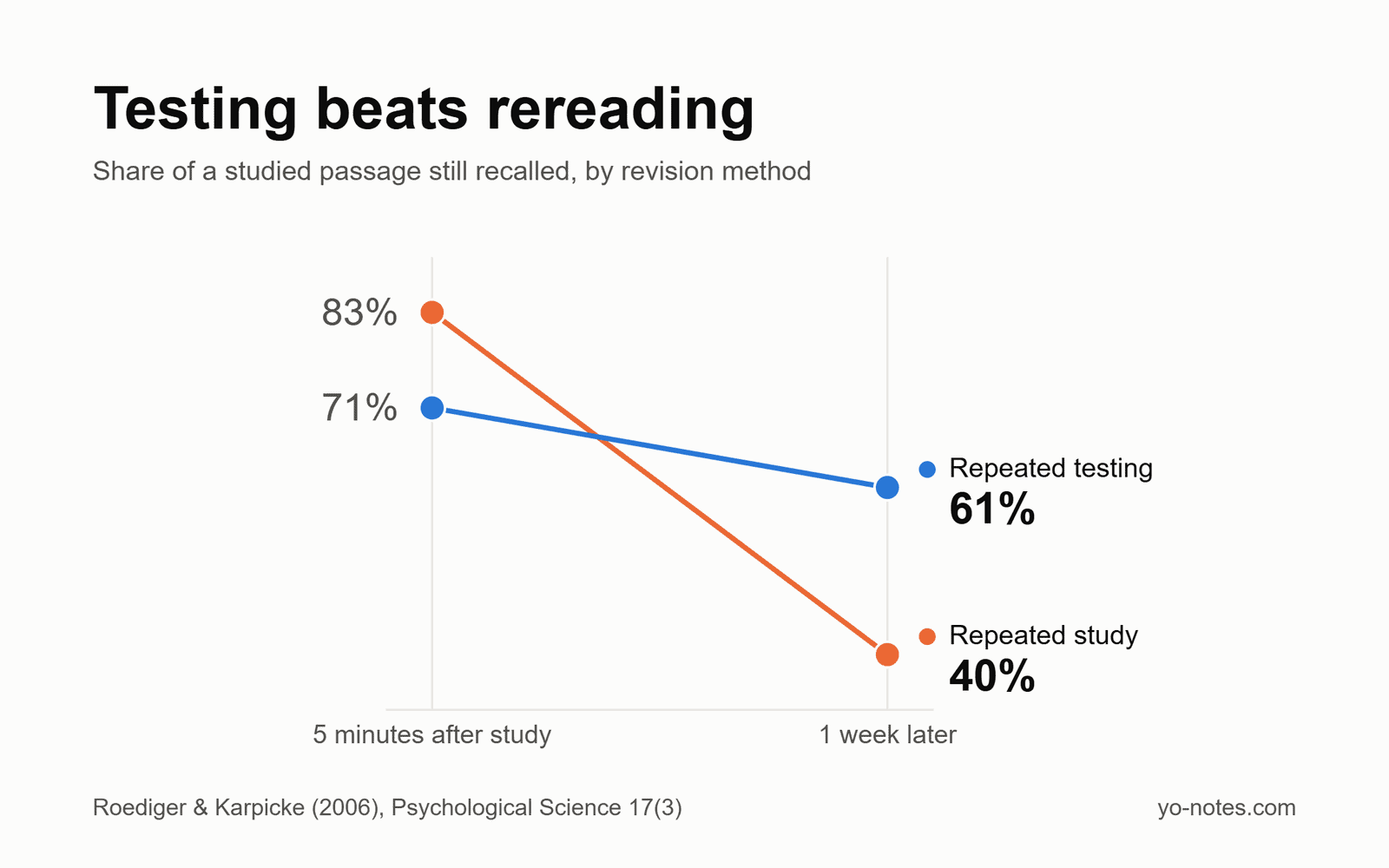
Space the Rounds: Come back two days later, then a week, then three weeks. Roediger and Karpicke found that repeated testing held 61 per cent recall after a week against 40 per cent for repeated study.
What This Method Does Not Fix
Mathematics Still Has to Be Worked: Explaining a solved problem is not the same as solving an unseen one. In Mathematics the questions you write should be problems to attempt, not concepts to recite.
The First Chapter Will Be Slower: This takes longer than reading twice, on the first chapter. By the fourth it is faster, because you stop rereading material you already hold. If you abandon it in week one, you abandon it before the saving arrives.
The Evidence Backs the Techniques, Not This Sequence: Retrieval practice, spacing and self-explanation are each well supported. Arranging them into these three passes is an inference from that work rather than a finding of it, and the order is worth adjusting to your subject.
Conclusion
The NCERT book is not the problem, and neither is your memory. The problem is that reading is the only thing most revision plans ask you to do with it. Survey it, explain it to yourself, then turn it into questions you answer with the book shut. The chapter takes longer the first time and stops needing you soon after.
Sixty days before a board exam, most Class 10 students are still reading. The syllabus is finished, the notes are made, and revision means going over the same chapters until they feel familiar. Familiar is not the same as recallable, and the exam only rewards the second one. Here is a plan built the other way round.
Start From the Marking Scheme, Not the Textbook
Download the Sample Paper and the Marking Scheme: CBSE publishes both, subject by subject, on cbseacademic.nic.in. Most students download the question paper and ignore the marking scheme, which is the more useful of the two because it shows how marks are actually split across an answer.
Read the Marking Scheme Before You Revise: It tells you what a full-mark answer contains: which steps carry marks, where a diagram is expected, how much a definition is worth. Revision aimed at that looks different from revision aimed at finishing the chapter.
Map Weightage Before You Map Time: Work out which units carry the most marks in each subject, then allocate your sixty days in proportion. Equal time per chapter is the most common planning mistake, and it quietly overspends on the smallest units.
Note the Mathematics Split: CBSE offers Mathematics in Basic and Standard versions, each with its own sample paper and marking scheme. Revise against the one you are entered for, not the one your friend is using.
The Two-Attempt Structure Changes the Calculation
February Is Compulsory, May Is Optional: From 2026, CBSE conducts the Class 10 board examination twice a year. The February examination is compulsory for everyone. The May examination is optional, for students who want to improve, with results following in April and June.
The Improvement Window Is Narrow: A student who has already passed may attempt up to three subjects from Science, Mathematics, Social Science and languages in the second phase. That is a correction mechanism, not a second syllabus and not a second chance at everything.
Plan for February as the Real Exam: Treating May as a safety net changes how hard you work in December, and not for the better. Build the whole plan around February. The optional attempt should end up being something you did not need.
Days 1 to 30: One Pass Through Everything
Cover Ground Before You Deepen It: The first thirty days are one complete pass through every subject. Speed matters more than polish here, because you cannot space your revision across chapters you have not yet reached.
Convert Each Chapter Into Questions the Same Day: Write the questions while you still know which parts were hard. A month later you will only write questions about what you already remember, which is exactly the material you do not need to practise.
Keep One Page Per Chapter: Compress each chapter to a single sheet: definitions, formulae, the two or three derivations that carry marks, and the diagrams you would be asked to label. Making the sheet is the revision. Reading it later is a bonus.
Rotate Subjects Within the Day: Two or three subjects a day rather than one subject a week. Mixing topics is rated moderately useful by Dunlosky and colleagues in their 2013 review, and it stops any subject from going cold for a fortnight.
Days 31 to 50: Spaced Recall and Full Papers
Return to Each Chapter on a Widening Gap: Revisit a chapter two days after the first pass, then a week later, then three weeks later. Cepeda and colleagues found in 2008 that the best gap grows as the test moves further away, landing near 10 to 20 per cent of the time remaining.
Sit Whole Papers Under Time: A full paper in one sitting trains what chapter-wise revision cannot: pacing, question selection and the stamina to keep handwriting legible in the third hour. Start these here, not in the final week.
Analyse the Paper, Do Not Just Score It: The score is the least useful output. Go through every lost mark and label it: did not know, knew but forgot, misread the question, ran out of time. Each label points to a different fix.
Carry Forward Only the Gaps: Mark every question solid, shaky or blank, and take only the shaky and blank ones into the next round. Roediger and Karpicke found that repeated testing held 61 per cent recall after a week against 40 per cent for repeated study.
Days 51 to 60: Narrow, Do Not Broaden
Stop Starting New Material: In the last ten days a new chapter costs more than it returns. The exception is a high-weightage unit you have genuinely never opened, and even then only the parts the marking scheme rewards.
Revise From Your Own Pages: Work from the one-page sheets you built in the first block, not from the textbook. If a sheet does not bring the chapter back, that chapter needs a recall round rather than another reading.
Rehearse the Conditions: Write at the time of day your paper is scheduled, on the same ruled sheets, with the same pen, and without your notes beside you. Familiar conditions remove one variable you would otherwise meet for the first time in the hall.
What This Plan Is and What It Is Not
The Evidence Covers the Method, Not the Calendar: Retrieval practice and spacing are well supported. Dunlosky and colleagues rated them the only two high utility techniques out of ten reviewed in 2013. The specific thirty, twenty and ten day split here is an inference from that work rather than a finding of it.
Adjust the Blocks, Keep the Structure: With ninety days, lengthen the first pass. With thirty, shorten it and protect the recall rounds. The order matters more than the numbers: cover everything, space the returns, then narrow.
Conclusion
Sixty days is enough for a full pass, three spaced recall rounds and a set of timed papers, provided nothing is left to the last fortnight. Download the sample papers and marking schemes before you plan anything else, because they decide what the plan should contain. The revision that fails is almost always the one that spent its first month reading and its last week panicking.
Most students revise by reading their notes again. It feels productive, and then the exam asks a question and the answer is not there. The problem is rarely effort. Recognition and recall are different skills, and rereading trains only the first. Two methods close that gap, and cognitive psychologists rate them above every other technique students commonly use.
What the Evidence Shows
Practice Testing and Distributed Practice Rank Highest: In 2013, Dunlosky, Rawson, Marsh, Nathan and Willingham reviewed ten common study techniques for Psychological Science in the Public Interest. Only two earned a high utility rating, meaning they worked across ages, subjects and ability levels: practice testing and distributed practice.
The One-Week Gap Is Large: Roediger and Karpicke tested this in 2006. Students read prose passages and either studied them again or took recall tests. Five minutes later the restudy group looked better, 83 per cent against 71 per cent. One week later the ranking reversed: 40 per cent for restudy, 61 per cent for repeated testing.
Forgetting Slows, Not Just Recall Improves: Over that week the restudy group lost more than half of what it had gained. The tested group lost about a seventh. Testing did not simply add a few marks. It changed how fast the material drained away.
Retrieval Beats More Elaborate Methods: Karpicke and Blunt put retrieval practice against concept mapping in Science in 2011, a far more effortful technique. Retrieval practice still produced more learning.
Popular Methods Score Poorly: Rereading, highlighting and underlining, summarisation and keyword mnemonics were all rated low utility in the same 2013 review. Interleaved practice, elaborative interrogation and self-explanation landed in the middle.
What Active Recall Actually Means
Produce, Then Check: Active recall means closing the book, producing the answer from memory, and only then checking whether you were right. Producing builds the memory. Checking keeps you honest. Both steps are required.
Not Rereading, Not Highlighting: If the answer is visible while you work, you are studying, not recalling. Copying notes into a neater book fails the same test. An exam will not keep the answer in front of you.
The Discomfort Is the Mechanism: Rereading feels smooth and recall feels hard, and students read that difficulty as failure. The 2006 data explains the trap. Restudying does win immediately, by twelve percentage points, but the advantage does not survive a week, and exams are not written the same afternoon you study.
Turning Your Notes Into Questions
Write Questions the Same Day: Convert the chapter into questions right after you first read it, while you still know which parts mattered. Questions written a month later tend to follow only what you already remember.
Use Four Question Types: Definitions, for what you simply have to know. Process questions, where you lay out a sequence or a derivation. Comparison questions, which force you to hold two ideas apart. Application questions, where a small change in the setup changes the answer.
Try the Blank Page Method: Write the topic name at the top of a sheet and put down everything you can remember without looking. Open your notes, mark what you missed in another colour, and revise only the coloured parts.
Bring In Past Papers Early: Past papers are the highest quality retrieval practice available, because they carry the wording of the examiner. Use them earlier than feels comfortable, not only in the final month.
Spacing Your Revisions
Gap and Delay Work Together: Cepeda, Pashler, Vul, Wixted and Rohrer synthesised 839 assessments from 317 experiments across 184 articles in 2006. The best gap between study sessions grows as the test moves further away.
Around 10 to 20 Per Cent of the Time Remaining: A 2008 study by the same group tested 1,354 participants across gaps of 0 to 105 days and delays of 7, 35, 70 and 350 days. For delays of a few weeks the optimal gap was roughly 10 to 20 per cent of the time until the test, falling to about 5 per cent at one year.
Translating It Into a Plan: This next step is an inference from the research rather than a finding of it, but the arithmetic is simple. An exam thirty days away suggests revisiting each topic every three to six days. Six months away suggests every two to four weeks. A year away suggests roughly every three weeks.
Run Four Passes Per Topic: Day 0, learn the topic and write the questions. Day 2, first recall round from memory, then check. Day 7, second round. Day 21, third round. Gaps measured in days and weeks, never compressed into one night.
Carry Forward Only the Gaps: Mark each question solid, shaky or blank. Only shaky and blank items travel to the next round, so the list shrinks each pass. If a topic still produces blanks by the third round, the explanation has not landed and rereading will not fix it.
Mistakes That Waste the Method
Making a Question for Every Line: Aim at the ideas an examiner can build a question on, not the full text of the chapter.
Practising Only What You Know: It feels good and teaches nothing. The blanks are the entire point of the method.
Rewriting Notes and Calling It Revision: Neat notes are a product, not a process. Time spent copying is time not spent retrieving.
Saving All Recall for the Last Week: That is cramming with extra steps, and it removes the spacing that does half the work.
Skipping the Check: Recall without verification will cement a wrong answer as firmly as a right one.
Conclusion
Nothing here asks for new material or more hours. It asks you to close the book earlier than feels comfortable, write questions on the day you learn a topic, and spread the rounds across weeks instead of stacking them the night before. The evidence for both habits is old, large and consistent. The hard part is only that the better method feels worse while you are doing it.